Home Philosophy Repertoire Contact

Pilateras

Repertoire

PiWall Repertoire

Every movement in the catalogue that can be performed on the PiWall.

10 movements

Clear filters
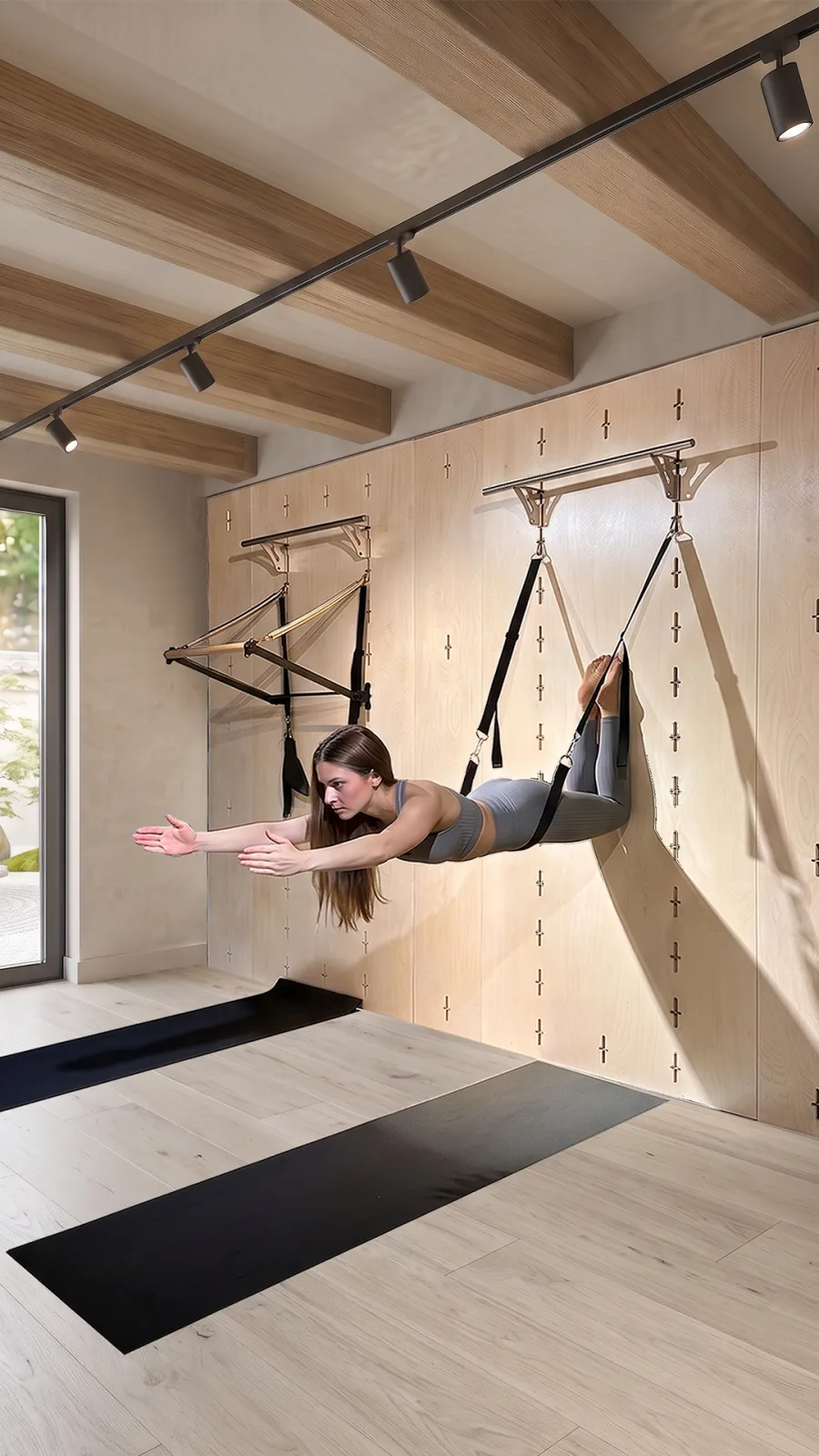
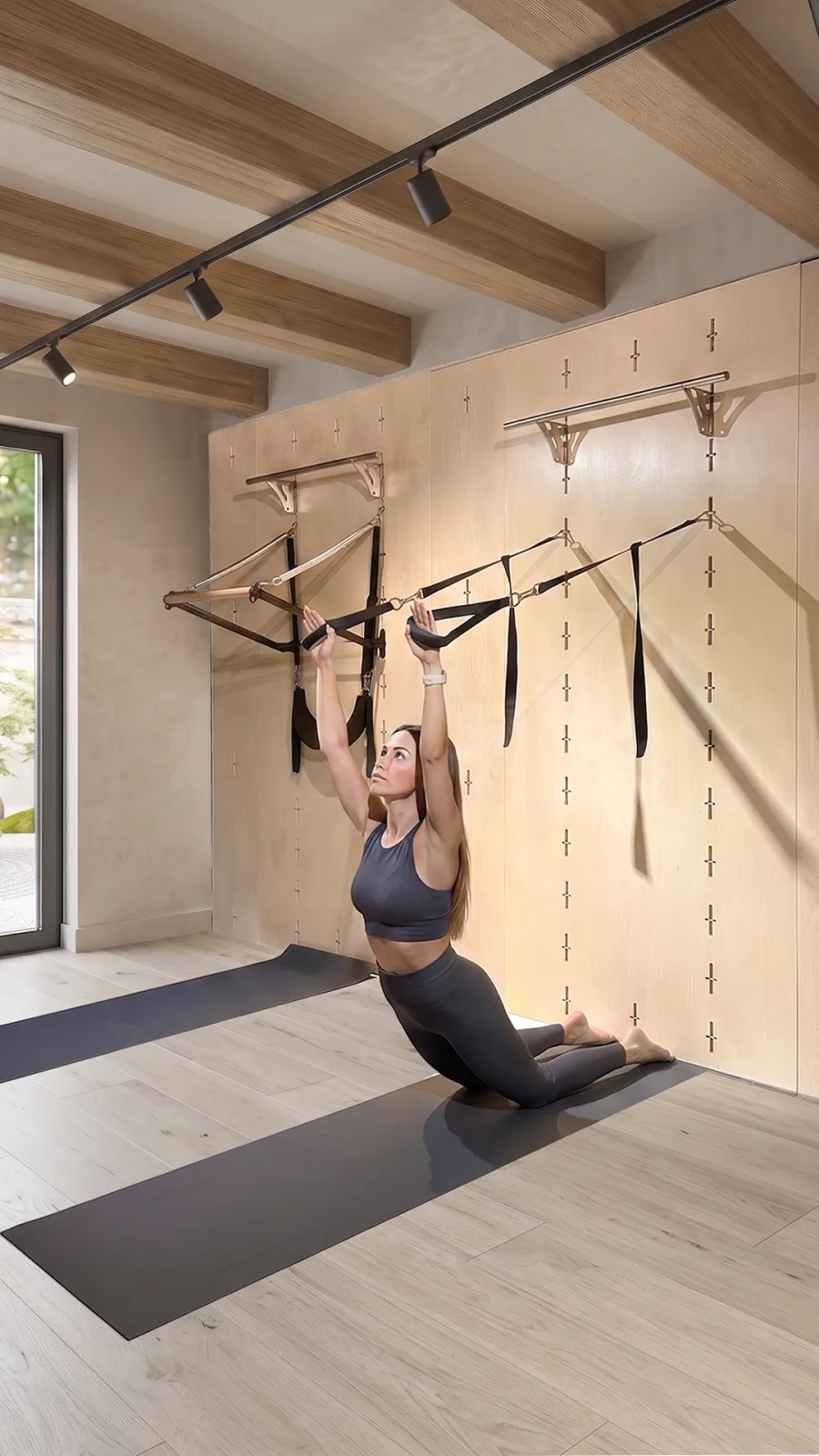
Salabhasana - Swan
Difficulty: 4/5 — Advanced PiWall

Salabhasana - Swan

In Yoga: It is fundamentally very similar to the Salabhasana (Locust Pose). Furthermore, because the torso is parallel to the ground and the arms are extended forward, it perfectly reflects the upper body sensation of an unsupported Virabhadrasana III (Warrior III) pose. In Pilates / General Fitness: It is an advanced, suspended variation of the prone Superman exercise or the Pilates Swan series, where the resistance of gravity is felt much more intensely.

Works  Since this movement requires holding the body in a straight line on a horizontal plane against gravity, it intensely activates the entire posterior chain and core region isometrically (static contraction): · Erector Spinae (Spinal Erectors) · Core Muscles · Gluteus Maximus (Glutes) and Hamstrings

Read the full breakdown
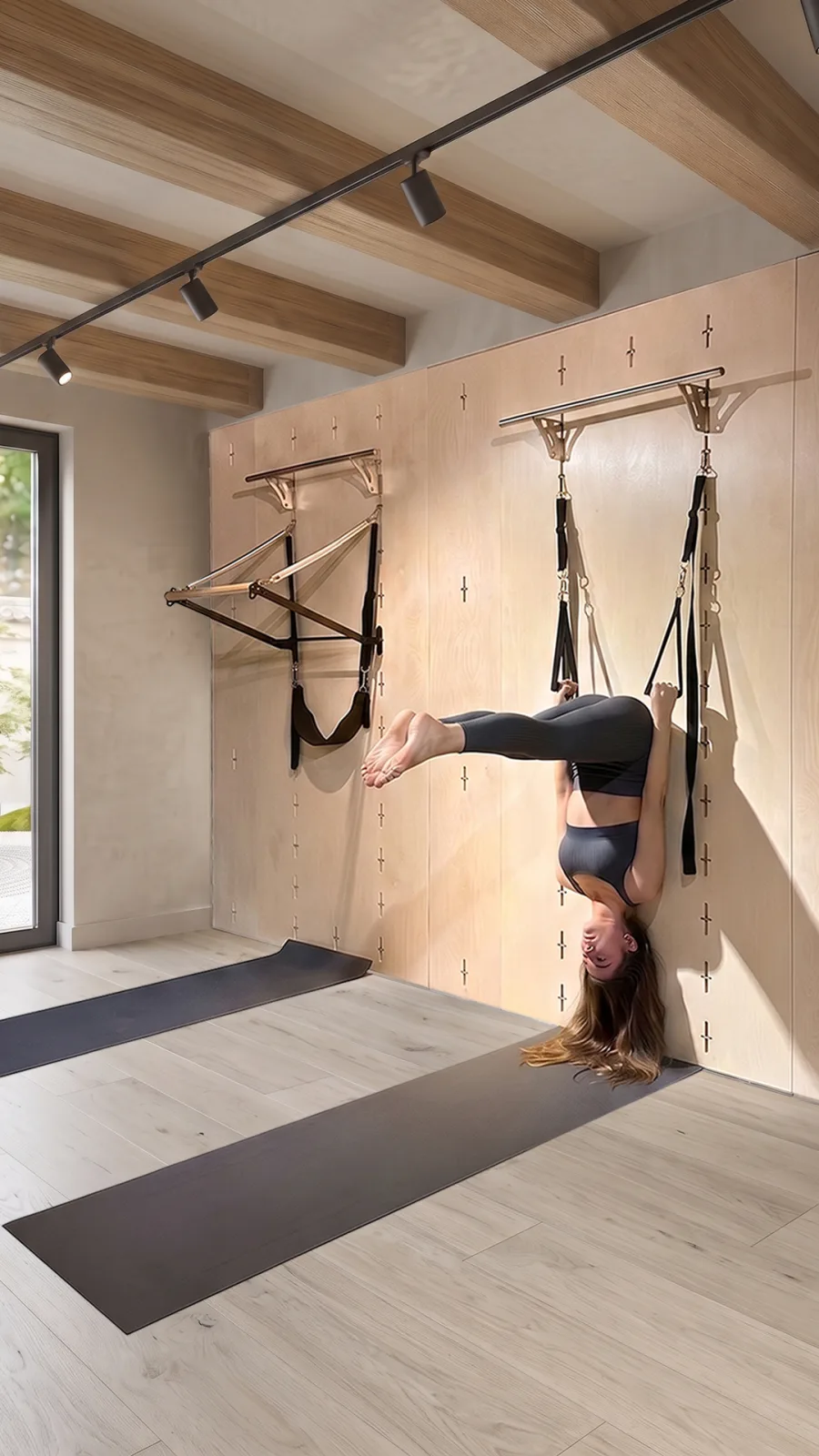
Inverted Pike - Teaser
Difficulty: 4/5 — Advanced PiWall

Inverted Pike - Teaser

In Yoga: It is most similar to "Inverted Pike" positions in aerial yoga. In traditional mat yoga, it can be thought of as an inverted version of Prasarita Padottanasana (Wide-Legged Forward Bend) or a combination of Sirsasana (Headstand) and Prasarita Padottanasana. Keeping the legs open against a vertical wall in this manner resembles an advanced, wall-supported variation of Sirsasana. In Pilates: It can be seen as a suspended, inverted version of the "Teaser" or "Roll-Over" exercises performed on the Pilates Reformer. It requires an intensity similar to the core and leg stability needed on the Reformer.

Works  This movement requires intense core and upper body engagement to balance the body in an inverted position and keep the legs at 90 degrees. The main muscle groups are: · Core · Upper Body · Legs and Hips

Read the full breakdown
Thigh Stretch - Ustrasana (Camel Pose)
Difficulty: 2/5 — Easy PiWall

Thigh Stretch - Ustrasana (Camel Pose)

In Pilates: It is most similar to the "Thigh Stretch" exercise commonly performed on the Cadillac or Reformer. While this movement is typically performed against the resistance of springs or a Roll-Down bar, here it is performed against body weight with the support provided by the yoga wall straps. In Yoga: It resembles the preparatory phase of Ustrasana (Camel Pose) or dynamic kneeling backbend sequences. While traditional Ustrasana involves touching the heels, the goal here is to work against gravity while keeping the torso straight. In General Fitness: It is an assisted version of the famous "Reverse Nordic Curl" exercise, known for promoting knee health and leg strength.

Works  This movement is a serious test of endurance and control, especially for the front of the legs and the core region: · Quadriceps (Front Thigh Muscles) · Core Muscles · Gluteus Maximus (Glutes)

Read the full breakdown
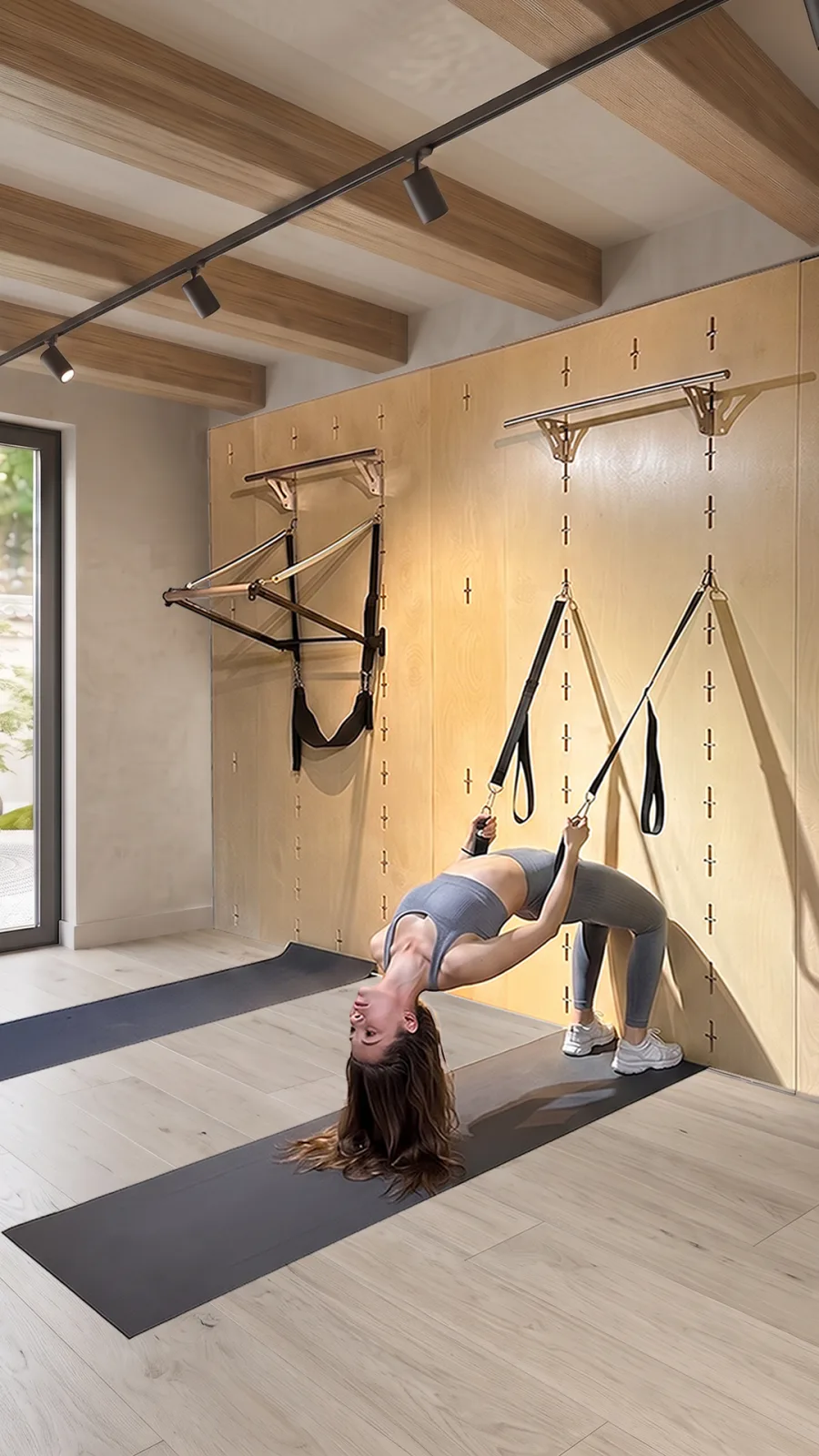
Urdhva Dhanurasana - Hanging Backbend
Difficulty: 3/5 — Intermediate PiWall

Urdhva Dhanurasana - Hanging Backbend

In Yoga: Fundamentally, it is an assisted version of the Urdhva Dhanurasana (Wheel/Full Bridge Pose) and Setu Bandhasana (Half Bridge Pose). Compared to the bridge pose performed on the floor bearing full weight on the wrists and shoulders, the straps allow gravity to pull the upper body down while the hips are pushed up. In Pilates: It is mechanically and in terms of spinal angle quite similar to the "Hanging Backbend" performed on the Cadillac (Trapeze Table) or the advanced "Semi-Circle" and bridging series on the Reformer.

Works  This movement actively engages the posterior chain while stretching the anterior chain of the body: · Gluteus Maximus (Glutes) and Hamstrings · Erector Spinae (Spinal Erectors) · Back and Arm Muscles (Latissimus Dorsi, Biceps, Deltoids)

Read the full breakdown
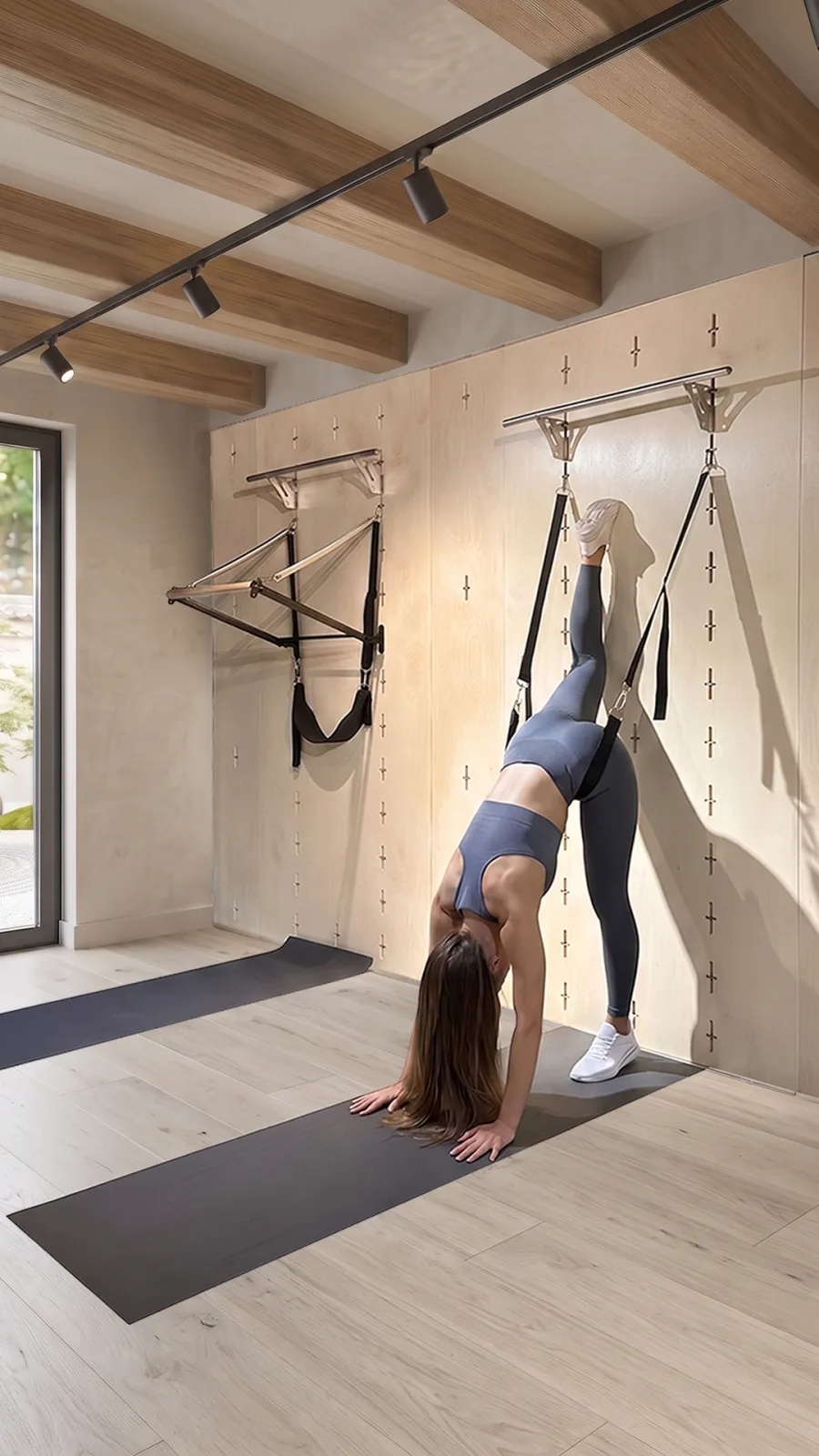
Eka Pada Adho Mukha Svanasana - Monkey
Difficulty: 2/5 — Easy PiWall

Eka Pada Adho Mukha Svanasana - Monkey

In Yoga: Fundamentally, it is a sling-supported version of the Eka Pada Adho Mukha Svanasana (One-Legged Downward-Facing Dog / Three-Legged Dog) pose. At the same time, due to the effort of opening the legs towards a 180-degree angle, it bears an exact resemblance to the Urdhva Prasarita Eka Padasana (Standing Split) pose. In Pilates: It is a much deeper, wall-adapted variation of the inverted hamstring stretch and "Monkey" series, which are typically performed on the Cadillac (Trapeze Table) with "Fuzzy" loops or spring assistance.

Works  This movement actively engages (strengthens) one half of the body while deeply stretching the other half and the posterior chain: · Hamstrings and Calves · Iliopsoas (Hip Flexors) · Shoulder Girdle and Arms (Deltoids, Triceps, Serratus Anterior)

Read the full breakdown
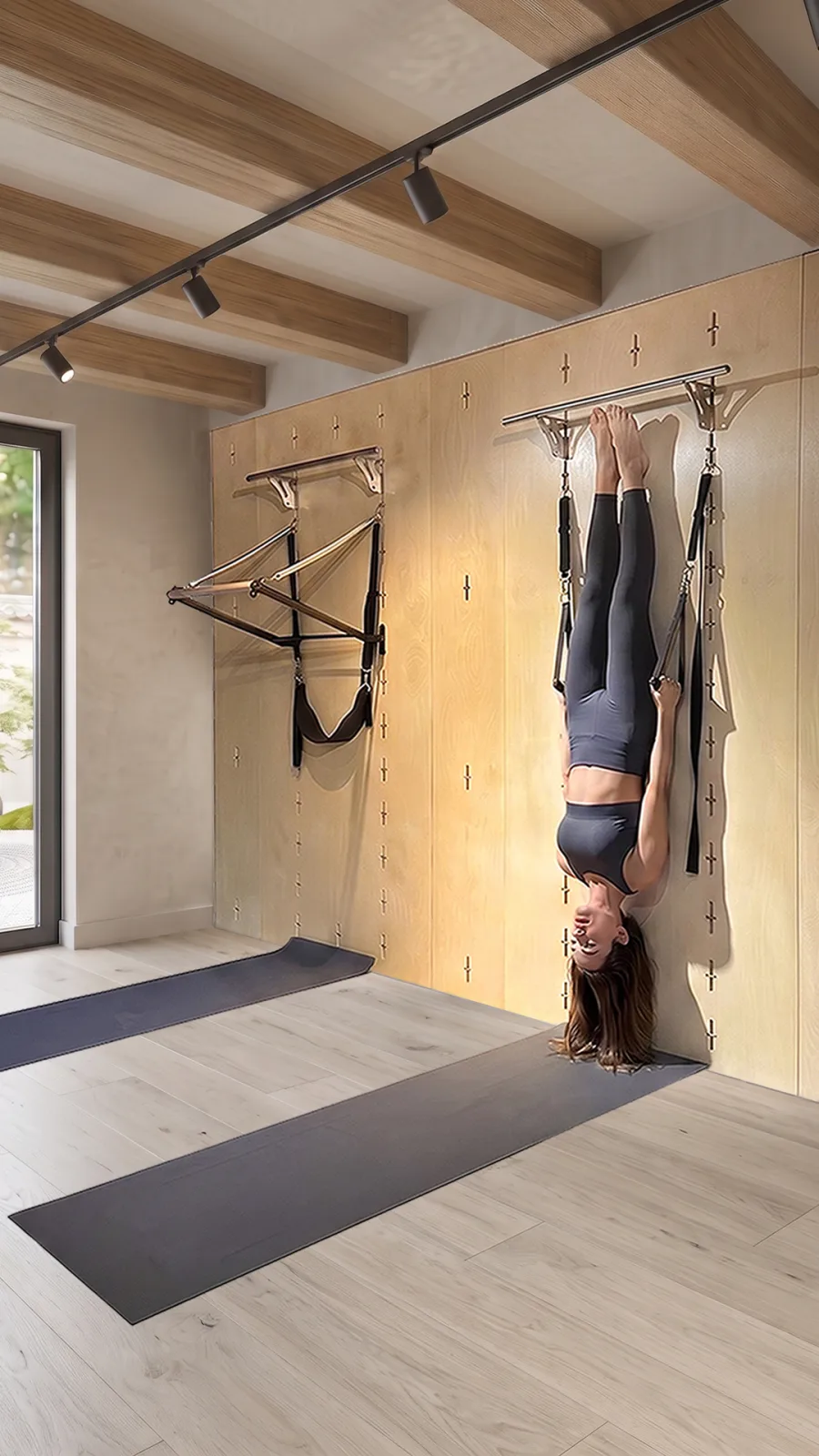
Adho Mukha Vrksasana - Full Inversion
Difficulty: 4/5 — Advanced PiWall

Adho Mukha Vrksasana - Full Inversion

In Yoga: It is a completely "weightless" (unburdened by gravity) version of the Sirsasana (Headstand) or Adho Mukha Vrksasana (Handstand) poses. It is the fully supported form of the "Rope Sirsasana" (Rope Headstand) practice frequently used in Iyengar yoga. It is also a wall adaptation of the inverted suspension (Bat Pose) positions found in Aerial Yoga. In Pilates: It exactly resembles the advanced "Full Inversion" or "Hanging" series performed on the Cadillac (Trapeze Table) using suspension apparatus ("fuzzies").

Works  This posture focuses on passive elongation and deep rest rather than active force production. However, to keep the body in a straight line (like a rope), some muscles continue to work isometrically (statically): · Core Muscles · Leg Muscles (Quadriceps and Glutes) · Forearm and Grip Muscles

Read the full breakdown
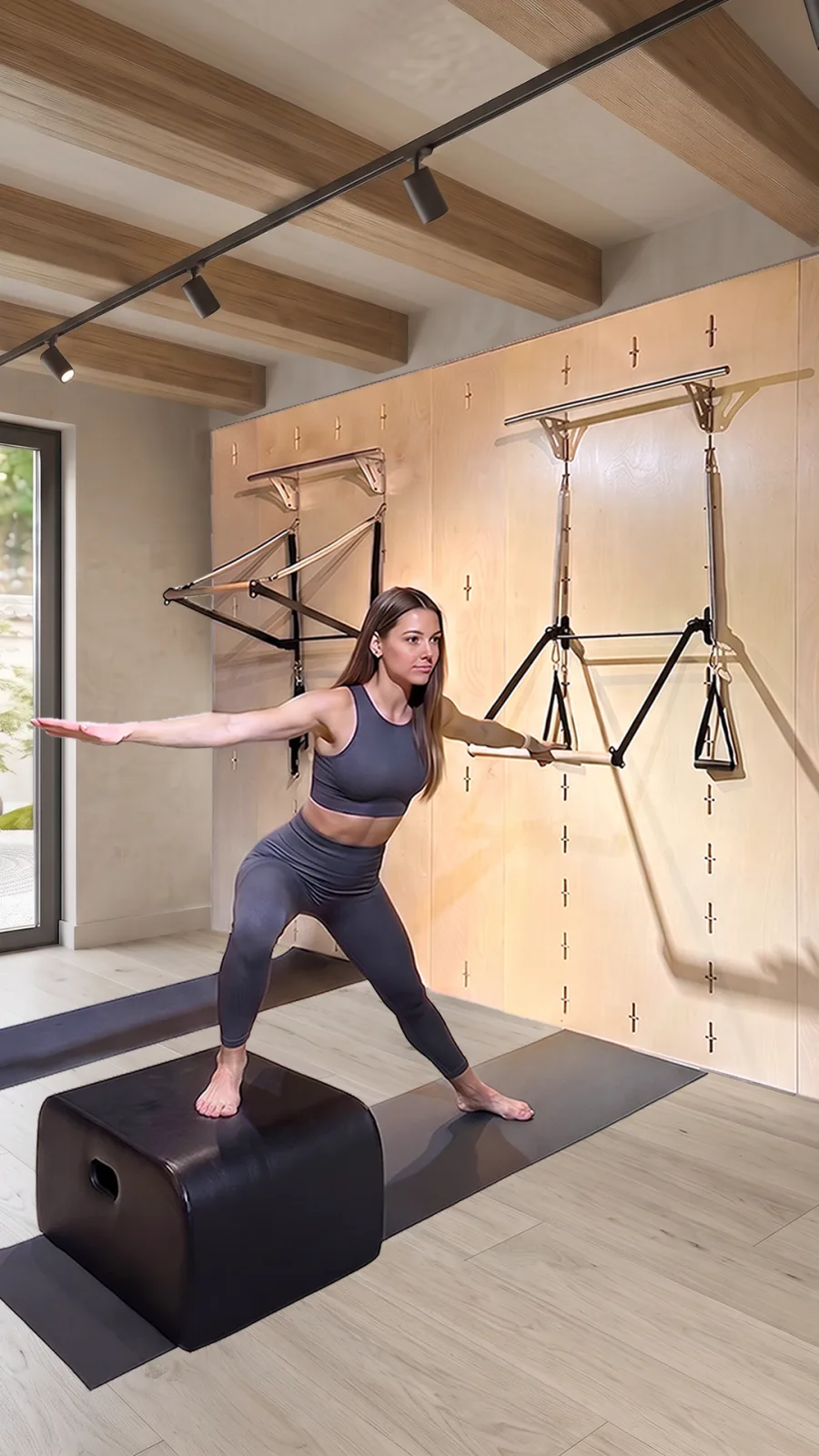
Virabhadrasana II - Standing Lunge
Difficulty: 2/5 — Easy PiWall

Virabhadrasana II - Standing Lunge

In Yoga: Visually and geometrically, it is most similar to the Virabhadrasana II (Warrior II) pose. This classic posture, where one leg is bent at 90 degrees, the other is extended straight, and the arms are opened parallel to the floor, is taken to a much deeper level with the use of a box. In Pilates: It is similar to the "Side Splits" performed on the Reformer or the "Standing Lunge" series performed with the addition of a box on the Wunda Chair / Reformer. The spring-loaded bar held in the hand perfectly reflects the arm and asymmetrical standing posture integrations performed on the Cadillac (Trapeze Table).

Works  This movement demands flexibility and strength simultaneously in the lower body (dynamic stabilization), while requiring the upper body to resist spring tension: · Quadriceps (Front Thighs) and Gluteus Maximus (Glutes) · Adductor (Inner Thigh) Muscles · Core and Obliques (Side Abs)

Read the full breakdown
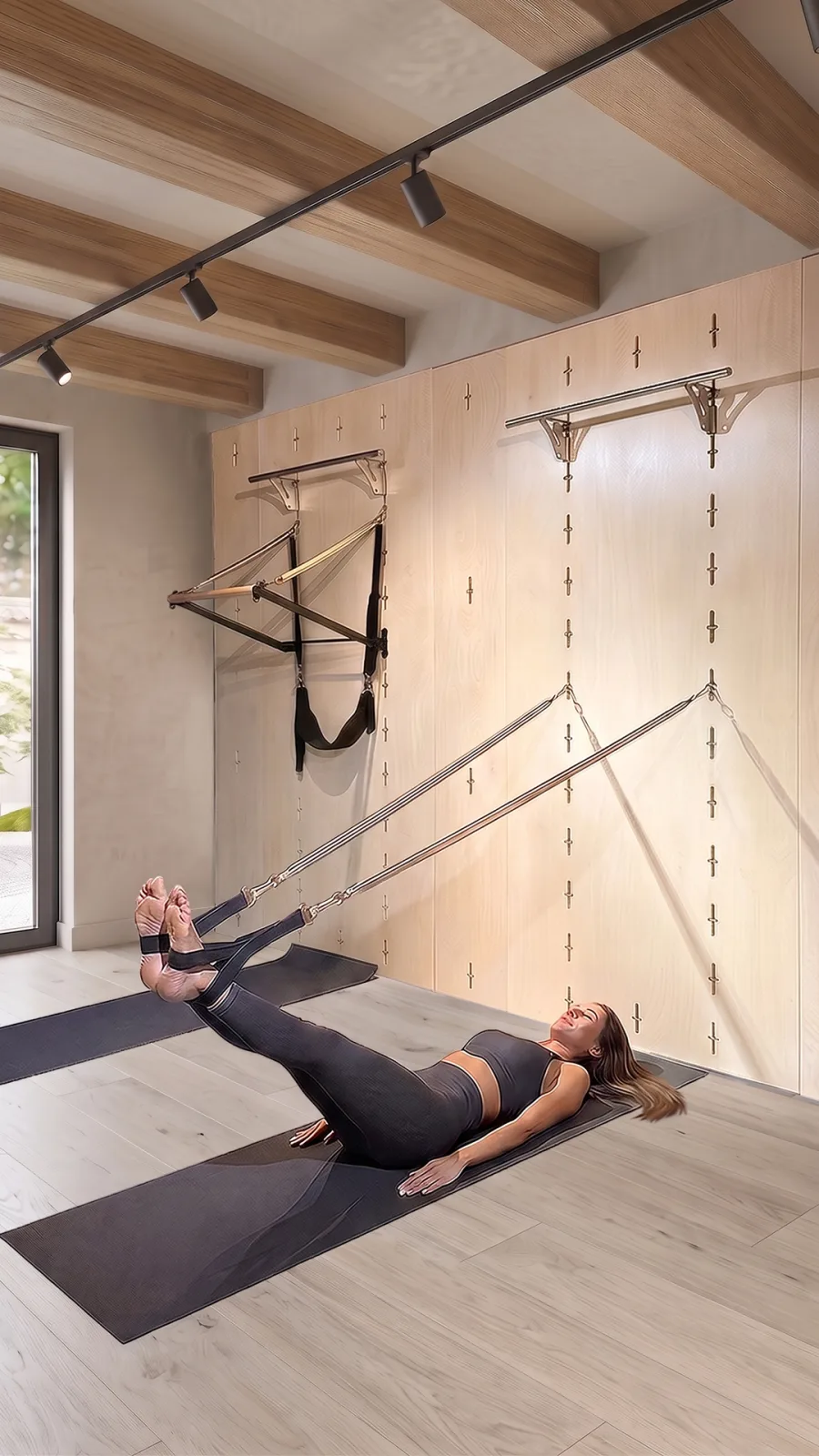
Feet in Straps - Urdhva Prasarita Padasana
Difficulty: 3/5 — Intermediate PiWall

Feet in Straps - Urdhva Prasarita Padasana

In Pilates: This movement belongs directly to the Pilates repertoire. It is a wall-adapted version of the well-known "Feet in Straps" series (specifically Leg Lowers/Lifts or Leg Circles) performed on the Reformer. Furthermore, it shares the exact same mechanics as the "Leg Springs" exercise series performed on the Pilates Cadillac or Springboard. In Yoga: It is similar to Urdhva Prasarita Padasana (Supine Double Leg Lifts/Lowers), which is performed lying flat on the back on a mat, raising and lowering the legs completely straight. However, while gravity is the only source of resistance in yoga, this version involves dynamic resistance created by the springs.

Works  Because this movement requires keeping the spine and pelvis stable (lumbo-pelvic stabilization) while moving the lower body, it is an excellent core exercise: · Core Muscles · Hamstrings and Gluteus Maximus (Glutes) · Iliopsoas and Quadriceps (Hip Flexors and Front Thighs)

Read the full breakdown
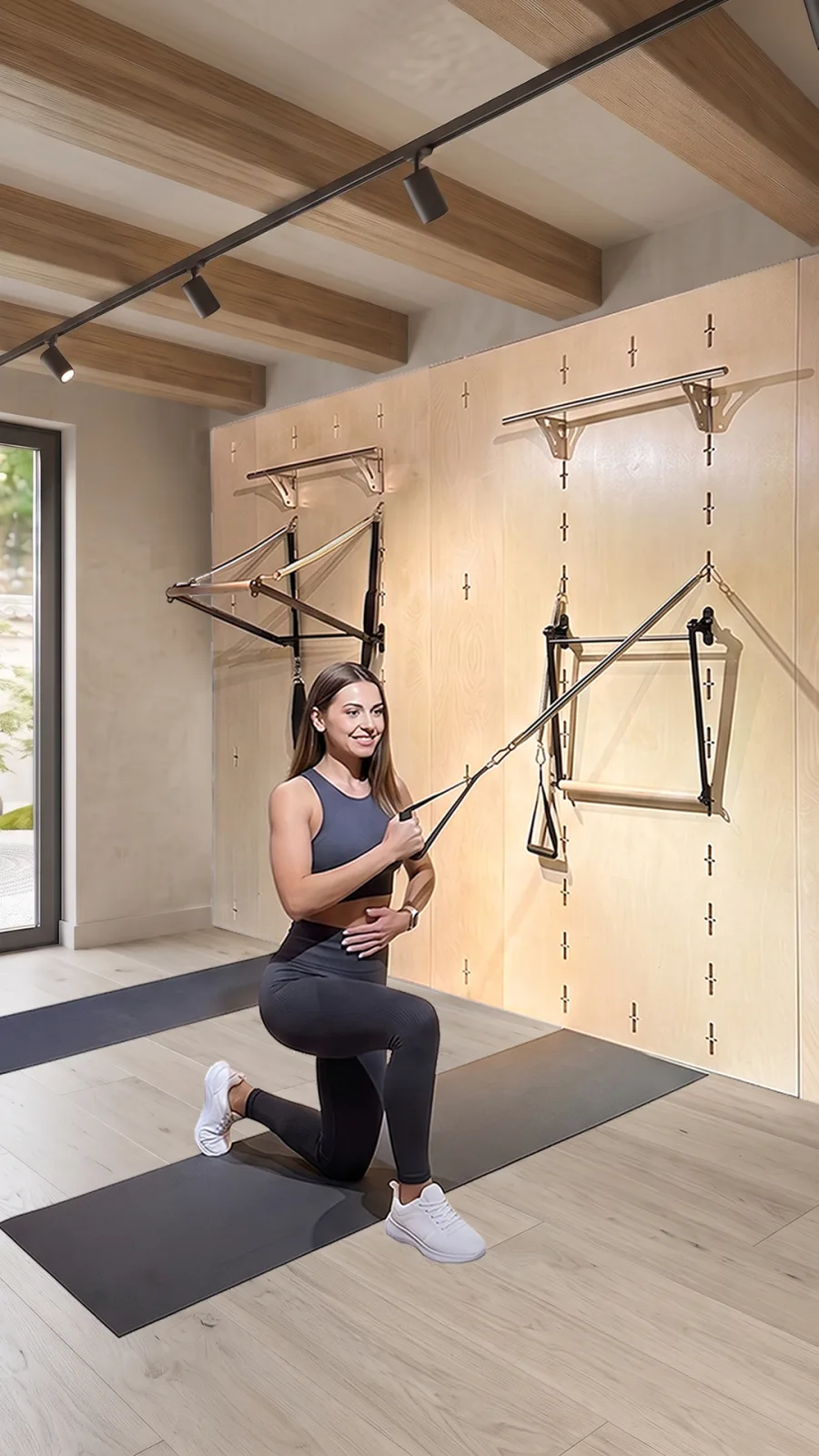
Kneeling Arm Springs - Anjaneyasana
Difficulty: 2/5 — Easy PiWall

Kneeling Arm Springs - Anjaneyasana

In Pilates: It exactly resembles the "Kneeling Arm Springs" series performed on the Cadillac (Trapeze Table) or Springboard, specifically the single-arm row and torso stabilization exercises. Since it involves resisting the tension that tries to rotate the body, it is essentially a Pilates-adapted "Pallof Press" or an anti-rotation control movement. In Yoga: In terms of the lower body stance, it is a more upright variation of the Anjaneyasana (Low Lunge) pose, aligned at 90/90 degree angles (half-kneeling). Although there is no pull resistance in yoga, the philosophy of keeping the core stable in an asymmetrical stance is based on the same foundation as balancing asanas.

Works  This movement is a functional "full-body" integration that combines lower body stabilization with the push/pull mechanics of the upper body: · Back and Arm Muscles · Core and Obliques (Side Abs) · Gluteus Medius and Pelvic Stabilizers

Read the full breakdown
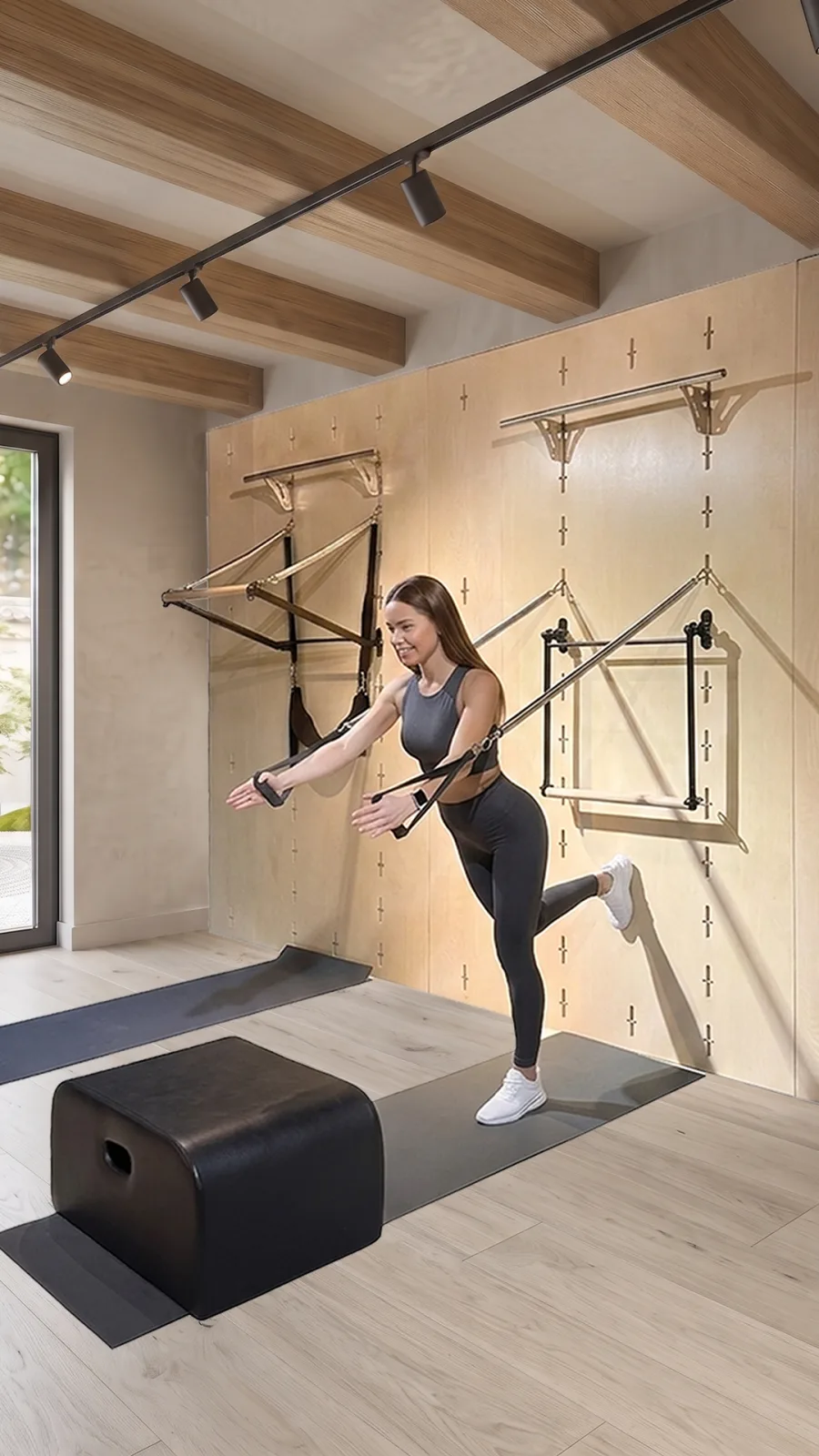
Standing Chest Press - Virabhadrasana III
Difficulty: 3/5 — Intermediate PiWall

Standing Chest Press - Virabhadrasana III

In Pilates: It exactly resembles the "Standing Chest Press" movement performed facing away from the wall on the Cadillac (Trapeze Table) or Springboard. However, resting the back leg against the wall and hinging the torso forward on a single leg (hip hinge) makes this movement just as complicated as the asymmetrical "Standing Lunge" on the Reformer or Wunda Chair balance series. In Yoga: In terms of the lower body's position, the forward alignment of the torso, and the element of balancing on one leg, it is very similar to the Virabhadrasana III (Warrior III) pose. While in yoga the arms are extended forward without support, here there is the action of pushing against the resistance of the springs. The bent back knee also resembles the foundation of Natarajasana (Dancer Pose) preparatory poses.

Works  This movement practically divides the body in two; while the upper body performs a dynamic push, the lower body and core region try to keep the body as still as a statue: · Chest and Arm Muscles (Pushing Force) · Core Muscles · Grounded Leg (Active Stabilizers)

Read the full breakdown

How the difficulty scale works

Every movement is rated from 1 to 5 on its biomechanical demands: core activation, upper-body strength, and the balance and flexibility it asks for.

Very easy
Fully supported, passive stretches performed on the floor.
Easy
Basic pulling, pushing and stretching from a stable base — seated, kneeling, or standing with support.
Intermediate
Exercises calling for active balance, moderate flexibility, or genuine core control.
Advanced
Active inversions, plank and flight shapes carried on full body weight — high core activation, shoulder mobility, and spatial awareness.
Very advanced
Acrobatic and gymnastic shapes demanding elite upper-body and abdominal strength to hold body weight stable against gravity.