Utthita Hasta Padangusthasana (Extended Hand-to-Big-Toe Pose) - Ballet Stretches
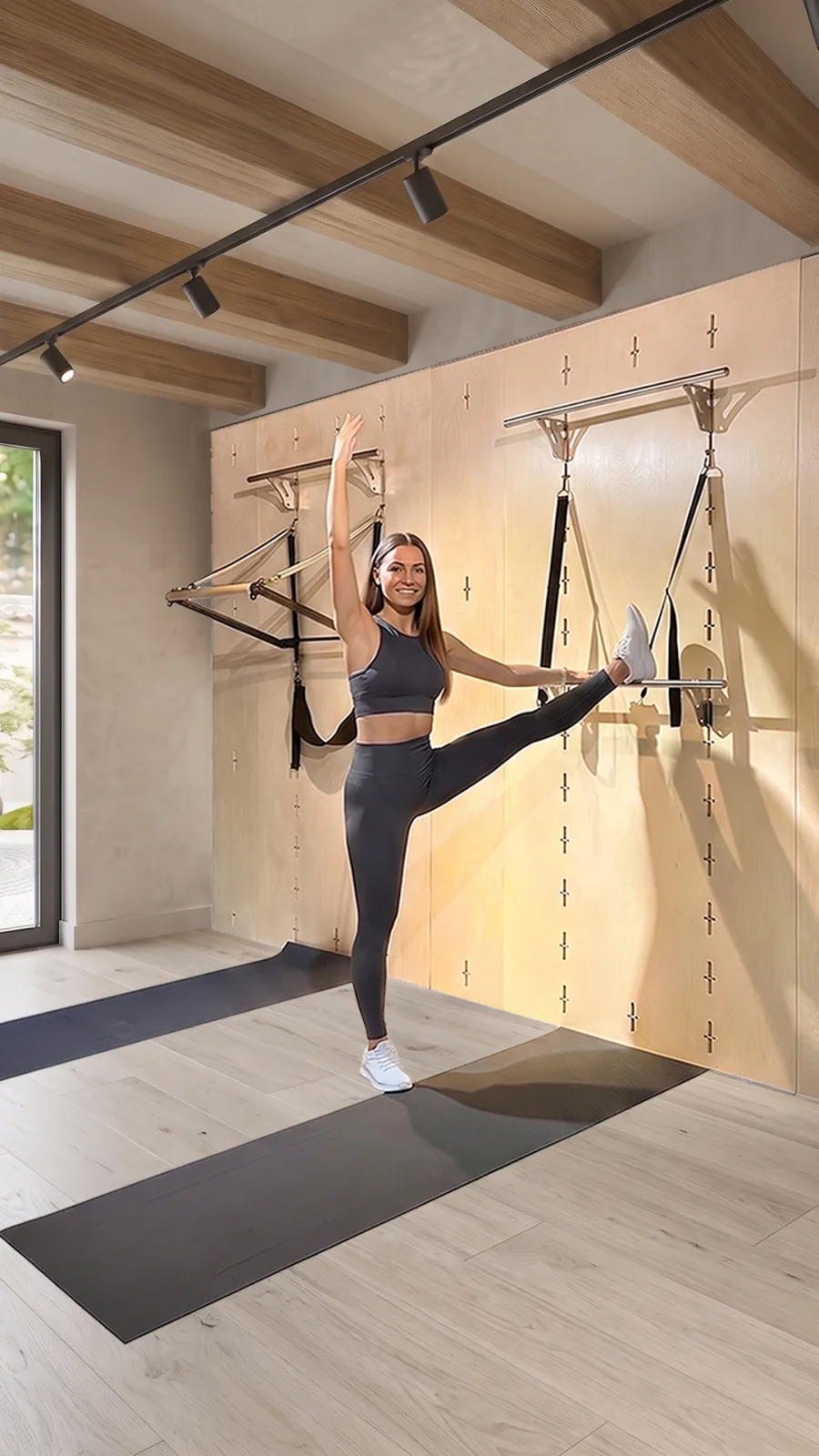
In Yoga: It is a supported version of the Utthita Hasta Padangusthasana (Extended Hand-to-Big-Toe Pose). Normally, this asana is held in balance unsupported by grabbing the big toe in the air; however, here, with the support of a bar, it is adapted to focus on deep flexibility rather than the element of balance. In Pilates / Barre: It exactly resembles the "Side" variation of the classic "Ballet Stretches" series performed on Pilates equipment (especially the Ladder Barrel, Cadillac, or Reformer tower). It is also one of the most fundamental stretching forms in Barre workouts.
Also known as
- In Yoga — Utthita Hasta Padangusthasana (Extended Hand-to-Big-Toe Pose)
- In Pilates / Barre — Ballet Stretches
Muscles worked
- This movement provides a deep stretch in one half of the lower body while requiring isometric (static) strength and balance in the other half:
- Stretching Muscles (Leg Extended on the Bar) — A very deep tension and elongation (stretch) occurs in the Adductor (inner thigh) muscles, as well as the Hamstrings (back of the leg) and Calf muscles.
- Active Stabilizers (Grounded Leg) — The Gluteus Medius (side hip) muscle, Quadriceps (front thigh) muscle, and small stabilizing muscles around the foot and ankle of the grounded leg remain constantly active to maintain the body's balance and stand upright.
- Core and Back Muscles — The Obliques (side abs) and deep spinal erector muscles work to prevent the torso from leaning (tilting) toward the bar and to keep the spine on a straight axis.
- Shoulder and Arm Muscles — While the Deltoid (shoulder) and Trapezius muscles are active in the arm extended towards the ceiling, the arm holding the bar supports balance with micro-adjustments.
What it gives you
- Deep Hip Mobility and Inner Thigh Flexibility — By stretching the inner thigh (adductor) muscles with safe support, it significantly increases the range of motion (ROM) in the pelvic region. It is an excellent preparation for split goals.
- Improved Balance and Proprioception — Trying to stand upright against gravity on a single leg trains the nervous system, increasing the body's spatial awareness (proprioception) and ankle strength.
- Asymmetrical Balancing — Because it works the right and left sides of the body separately (unilaterally), it helps identify and correct flexibility and strength imbalances between the two legs.
- Axial Elongation in the Spine — Reaching the arm straight up and activating the core helps create space between the vertebrae (elongation), making the posture more upright and graceful.
Why it is rated Easy
A standing bar-supported side leg raise, a basic barre/stretch exercise.