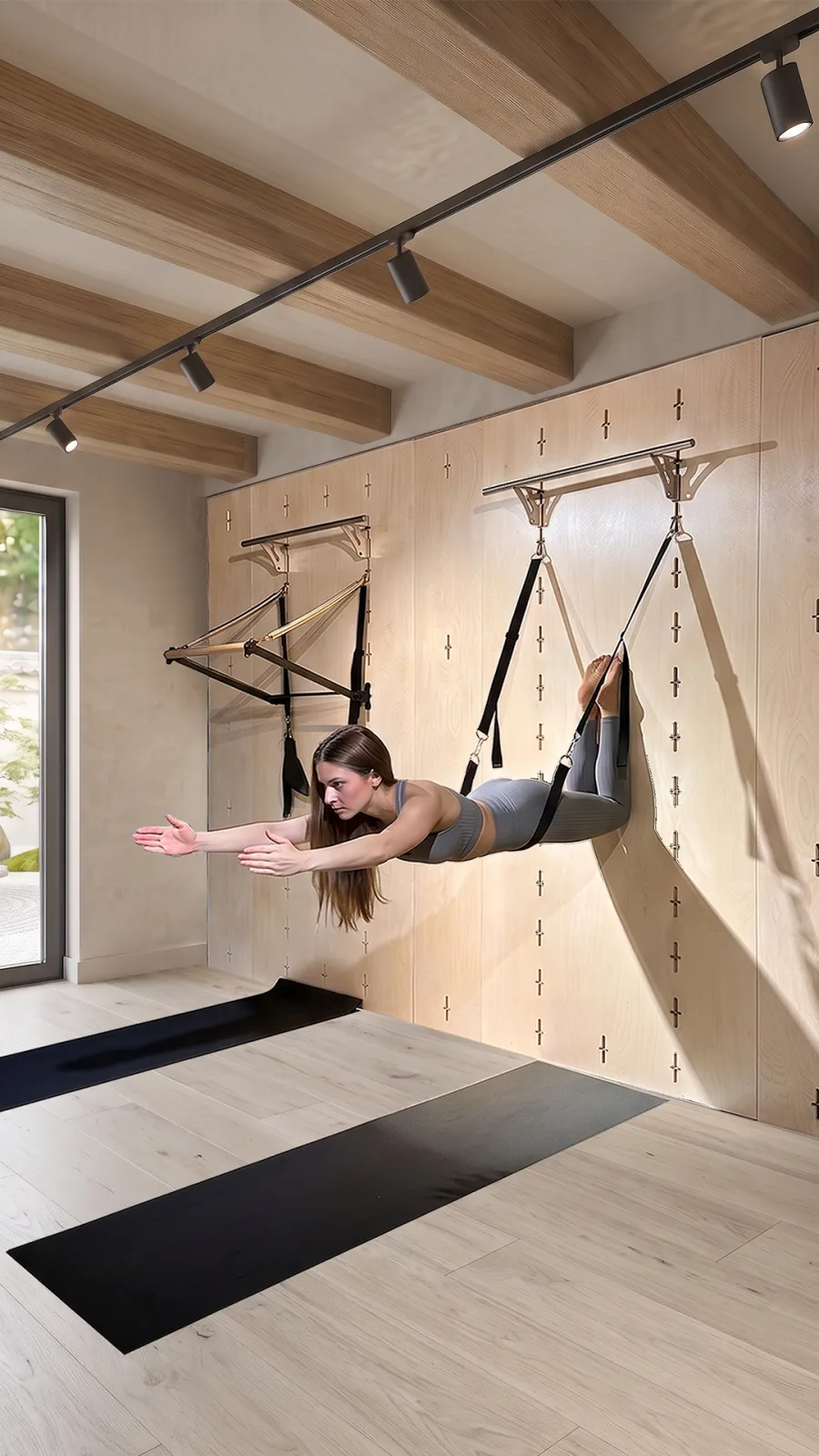
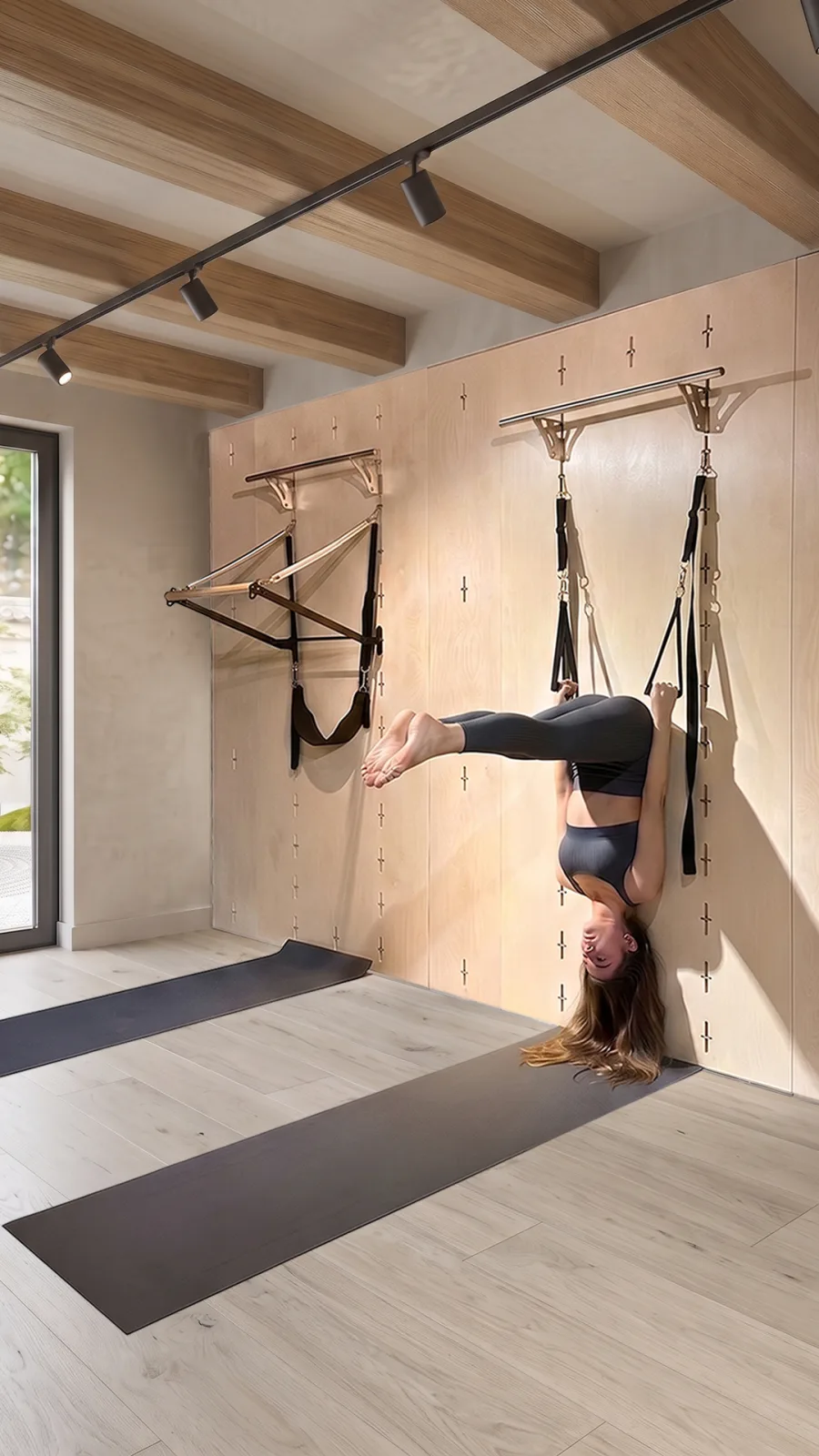
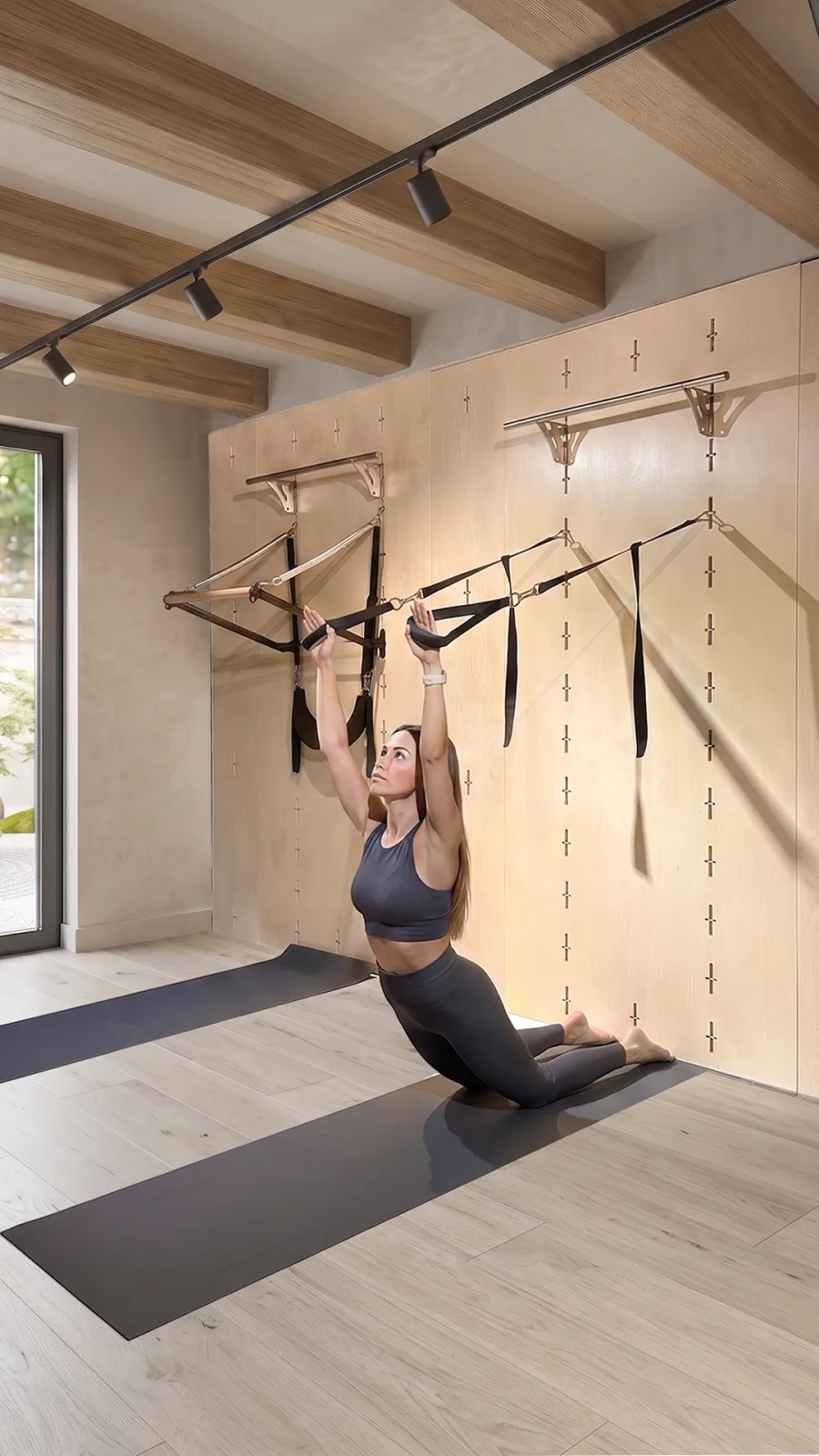
Control Balance - Eka Pada Halasana (One-Legged Plow Pose)
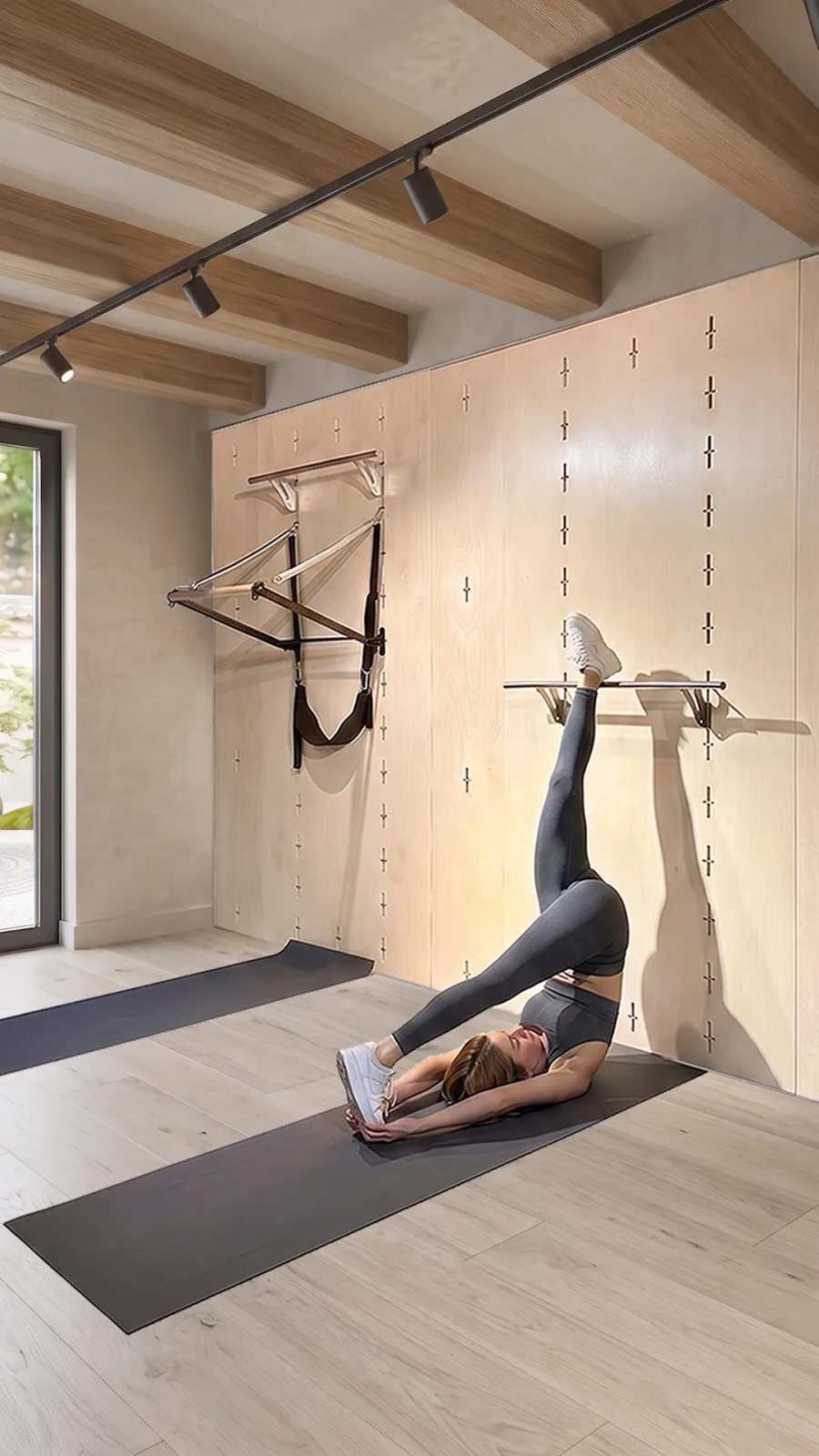
In Pilates: It is a wall-adapted version of the advanced "Control Balance" or "Scissors" movements from the mat series. In this balancing movement, which is performed unsupported in classical Pilates, the wall bar stabilizes one leg, maximizing the stretching dimension of the exercise. It is also quite similar to the mechanics of the inverted stretch (Tower/Monkey) series performed with the help of the "Push-Through Bar" on the Cadillac. In Yoga: It is a perfect combination of the Eka Pada Halasana (One-Legged Plow Pose) and Eka Pada Sarvangasana (One-Legged Shoulderstand) poses. The leg that is held in the air in classical yoga is supported by the bar here, while the other leg is extended behind the head into a Plow form.
Muscles worked
- This movement creates an intense stretch (elongation) in one half of the body while demanding a strong isometric (static) contraction in the core region to remain suspended in the air:
- Maximum Stretching Muscles (Focal Point) — The entire posterior chain of the leg lowered behind the head and grasped by the hands; specifically, the Hamstrings (back of the leg) and Gluteus Maximus (glutes) undergo the deepest stretch. Additionally, the Erector Spinae (spinal erectors) lengthen from the neck down to the tailbone.
- Active Stabilizers (Upper Leg) — The Quadriceps (front thigh) muscles of the leg resting on the bar are constantly active to keep that leg completely straight. The hamstring muscles also remain engaged to prevent the hips from dropping to the floor.
- Core Muscles — The Transversus Abdominis (deep abs) and Rectus Abdominis lock the body to ensure the pelvis remains suspended without tilting to the right or left in the air, and without losing the form of the lower back.
- Upper Body (Shoulders and Neck) — Since the weight is on the shoulder girdle, the shoulders and Triceps (back of the arm) muscles gently push the mat downward to prevent excessive strain on the cervical vertebrae.
What it gives you
- Advanced Posterior Chain Flexibility (Hamstrings/Lower Back) — Thanks to the balance support provided by the bar, the person does not fear falling and can direct all their focus to the stretch of the leg extended behind the head. This deepens the passive stretch, allowing for much faster flexibility gains than an unsupported pose.
- Deep Spinal Flexion and Relaxation — Rolling the spine forward (flexion) in this manner stretches the ligaments between the vertebrae, relieves the discs, and reduces stress by soothing the nervous system (parasympathetic activation).
- Benefits of Inversion — Having the legs and pelvis higher than the heart and head facilitates the return of venous (deoxygenated) blood and lymphatic fluid to the heart. It clears fatigue and edema in the legs while carrying fresh, oxygenated blood to the face and brain regions.
- Body Awareness (Proprioception) — Trying to manage the legs asymmetrically while the rib cage is close to the chin and the body is inverted highly develops the brain's ability to perceive and control the body in space.
Why it is rated Intermediate
A supine floor split; although the movement is technically simple, performing it at a full angle requires significant flexibility.