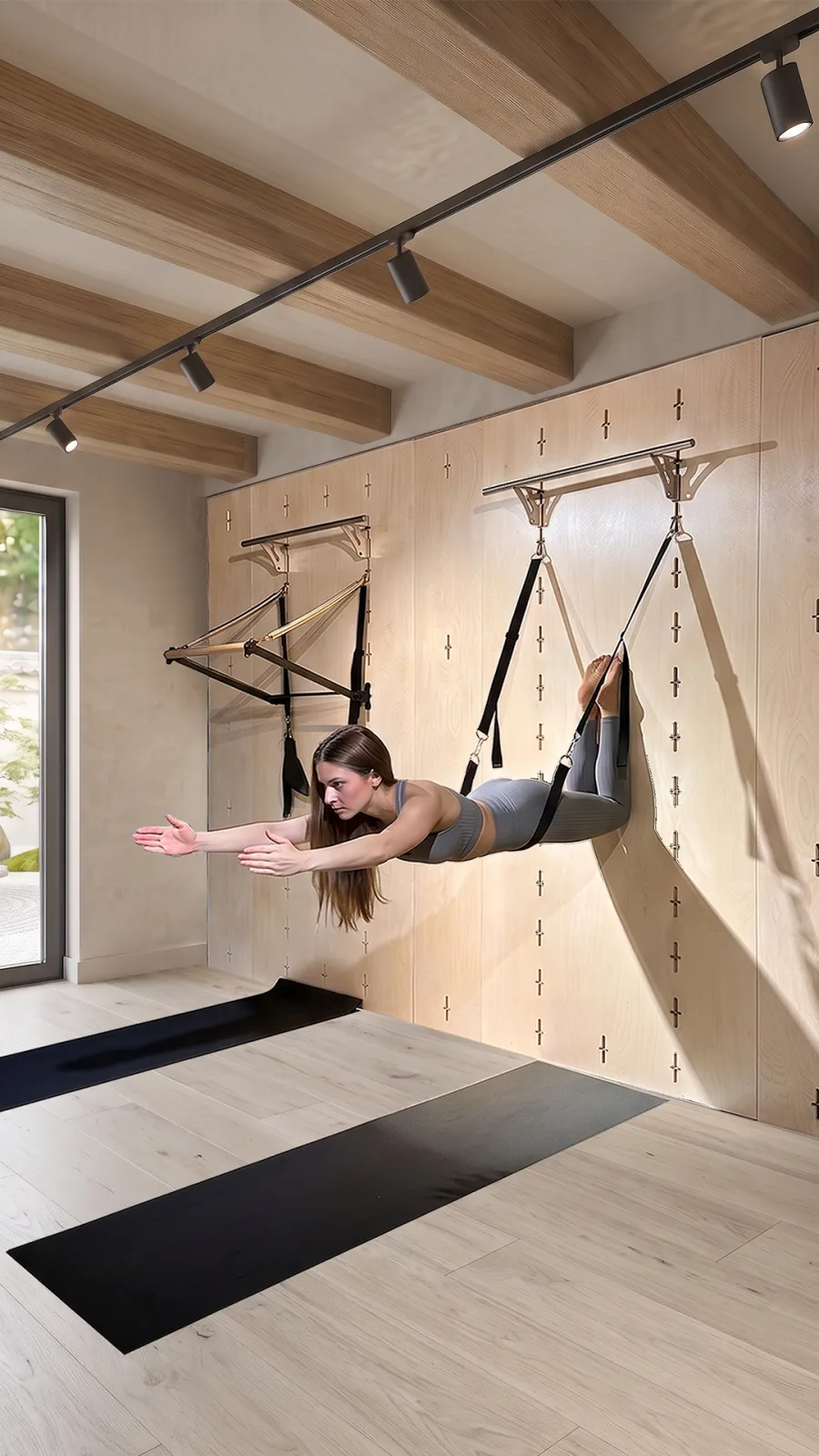
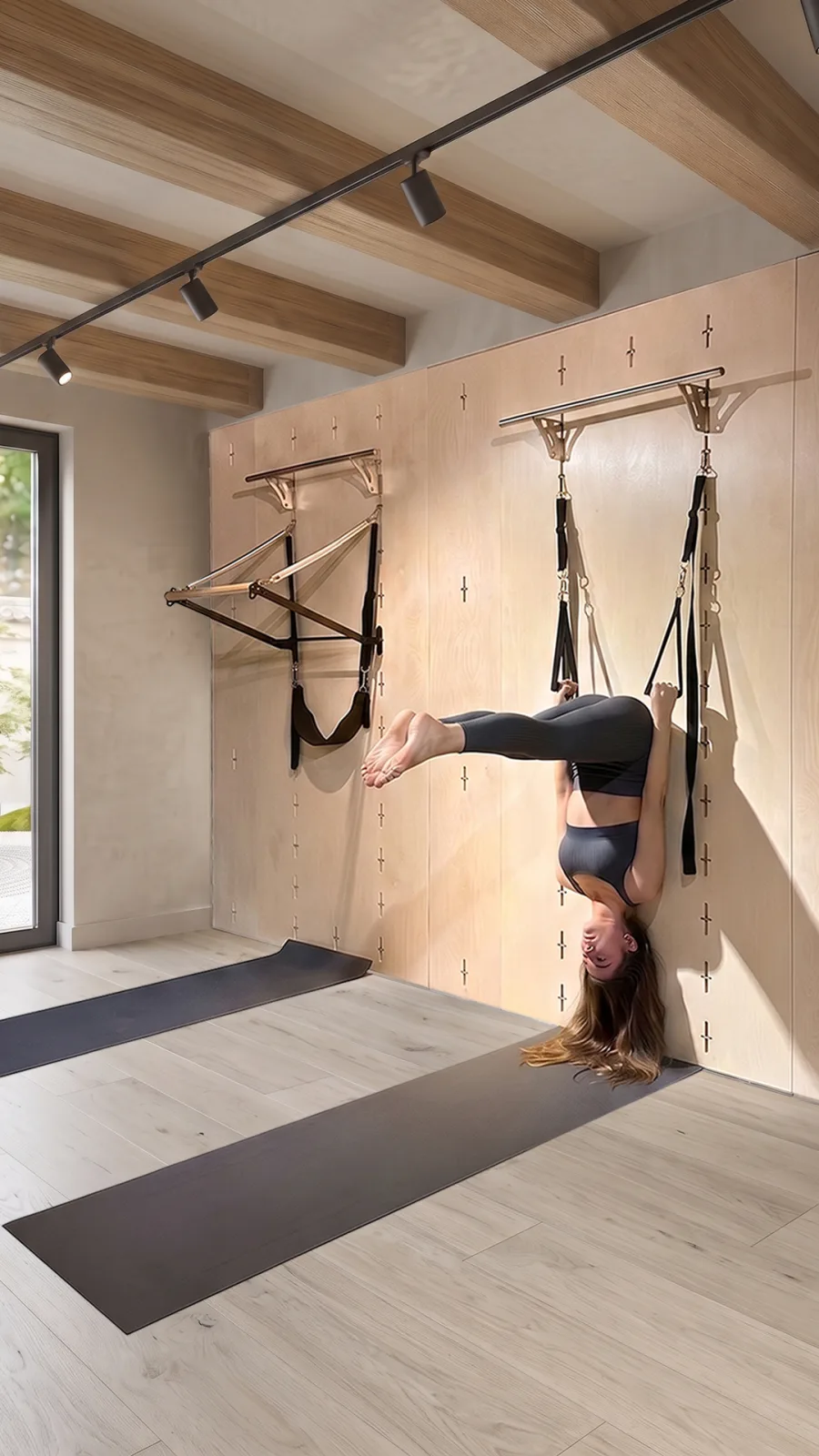
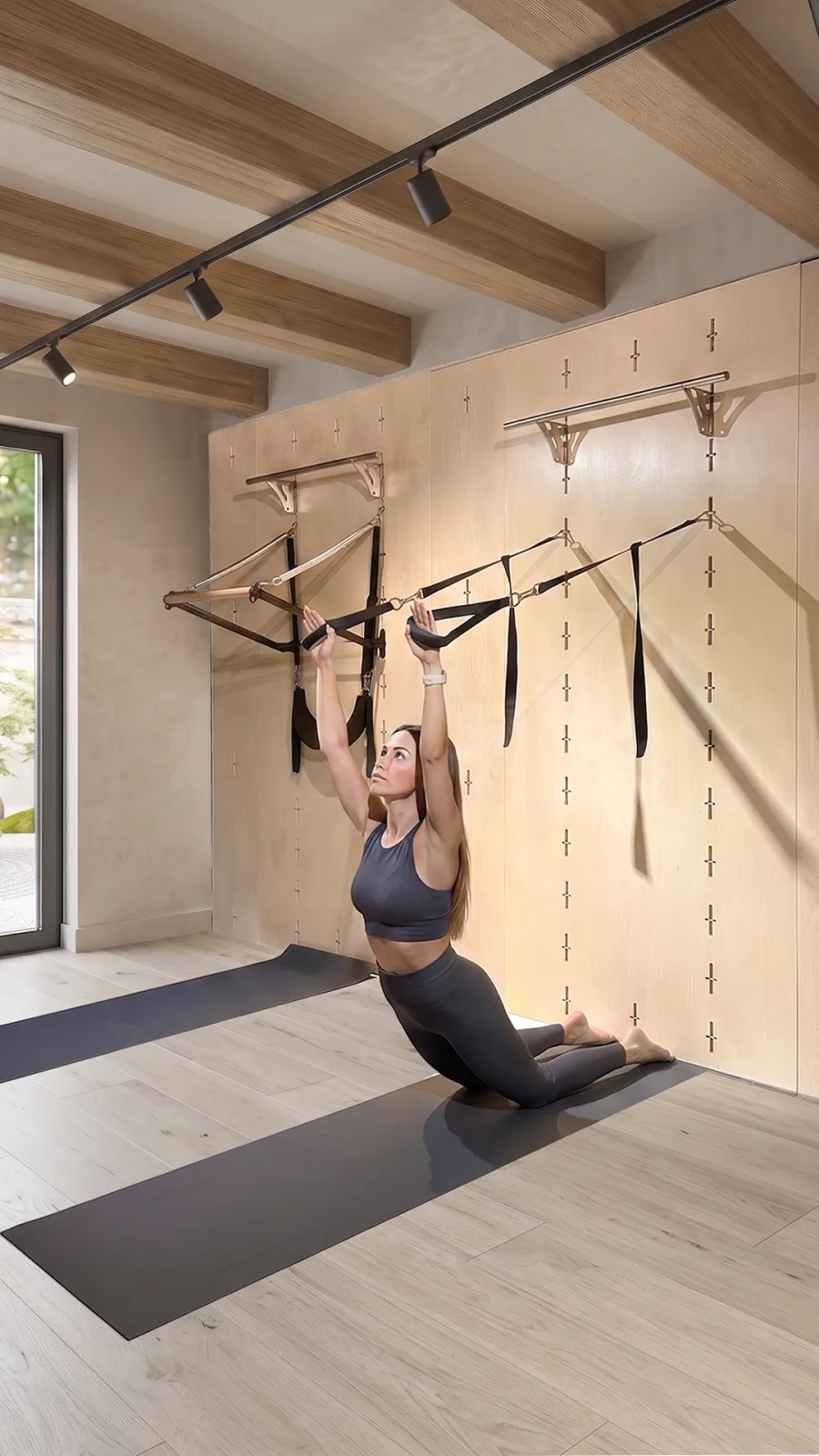
Phalakasana - Long Stretch
Difficulty: 3/5 — Intermediate
PiWall
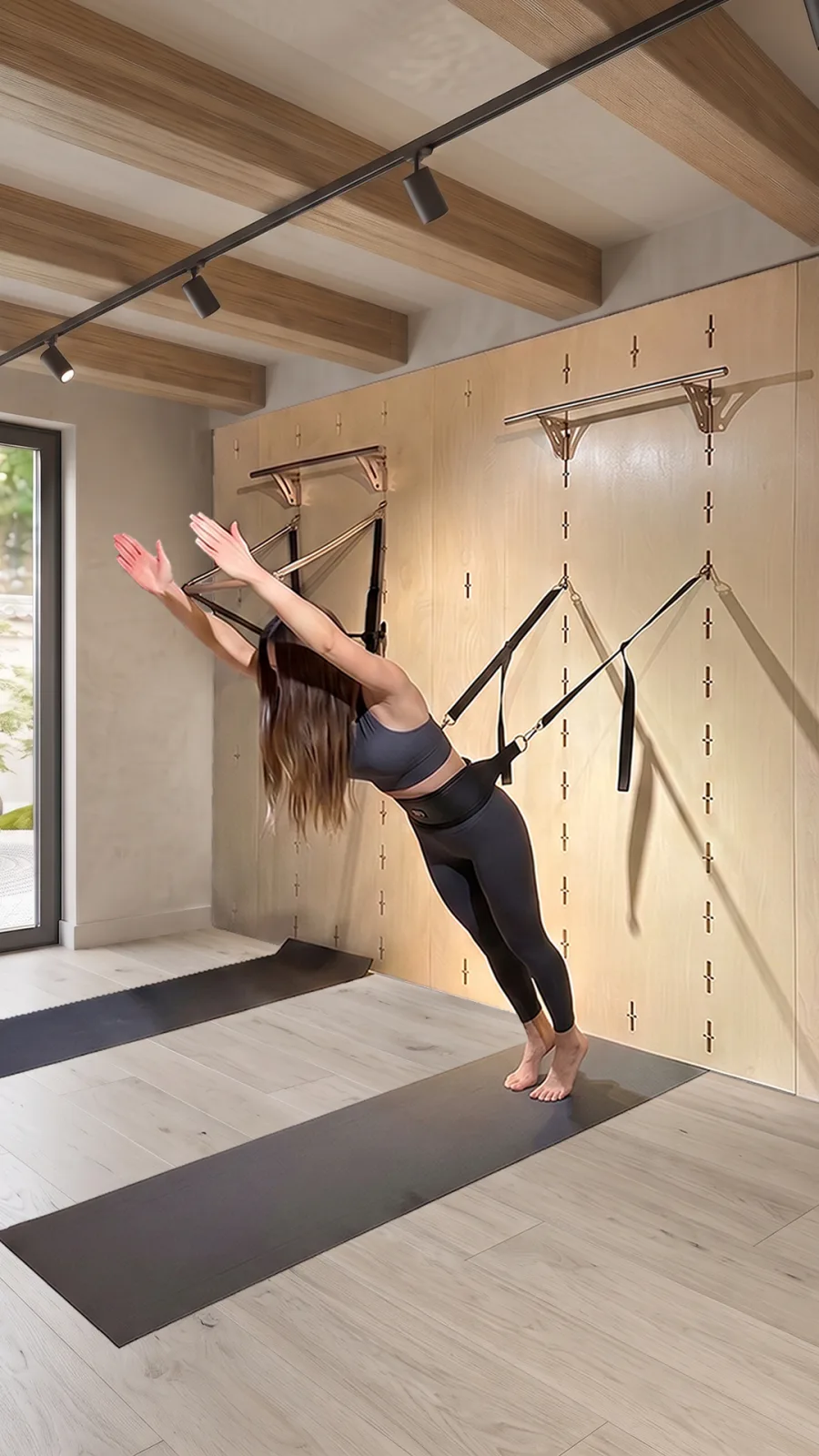
In Yoga: Fundamentally, it is an adapted, standing, angled version of Phalakasana (Plank Pose) against gravity. At the same time, because the arms extend upward and forward, it can be considered a resisted form of Urdhva Hastasana (Upward Salute Pose) or a practice of Virabhadrasana III (Warrior III) where the feet remain on the ground. In Pilates: It is the exact standing equivalent of the famous "Long Stretch" series performed on the Reformer or "The Lean" posture on the Wunda Chair. The goal is to keep the body stable and unbending "like a board" (plank).
Also known as
- In Yoga — Phalakasana
- In Pilates — Long Stretch
Muscles worked
- While the strap supports the hips, the entire posterior chain of the body works with a tremendous isometric (static) contraction to prevent the upper torso from falling forward (toward the ground) due to gravity:
- Erector Spinae (Spinal Erectors) — All back and lower back muscles from the tailbone to the neck are actively engaged to prevent the torso from folding or bending forward.
- Gluteus Maximus (Glutes) and Hamstrings — The glute and hamstring muscles are squeezed very tightly to prevent the hip joint from bending (folding) and to keep the body completely straight from the heels to the crown of the head.
- Deltoids (Shoulders) and Trapezius — The shoulder and upper back muscles work intensely to keep the arms aligned with the torso (next to the ears) without dropping them against gravity.
- Core Muscles — While the back muscles are working, the Transversus Abdominis (deep abdominal muscle) remains active to prevent excessive arching of the lower back and to wrap the spine like a corset.
- Gastrocnemius and Soleus (Calves) — Rising on the tiptoes (relevé) to support the forward-leaning angle of the torso constantly engages the calf and ankle stabilizers.
What it gives you
- Perfect Posture Training — Trying to keep the body in a completely straight alignment against gravity reprograms the nervous system's perception of "proper and upright posture" (neuromuscular memory). It is an excellent corrector against hunching (kyphosis).
- Posterior Chain Endurance — By strengthening the back, lower back, and glute muscles—which often weaken due to our constant forward-leaning modern lifestyle—simultaneously, equally, and for a prolonged duration (isometrically), it minimizes the risk of lower back pain.
- Full-Body Tension Control — This movement, which does not allow any part of the body to relax, teaches how to control the entire body from the tips of the toes to the fingertips as a single unit (fascial chain) rather than isolating muscles.
- Shoulder Girdle Strength — Holding the arms in the air at this angle for a long time against gravity without using weights significantly increases the functional endurance of the shoulder joint.
Why it is rated Intermediate
A standing forward plank leaning into the straps; requires core stabilization.