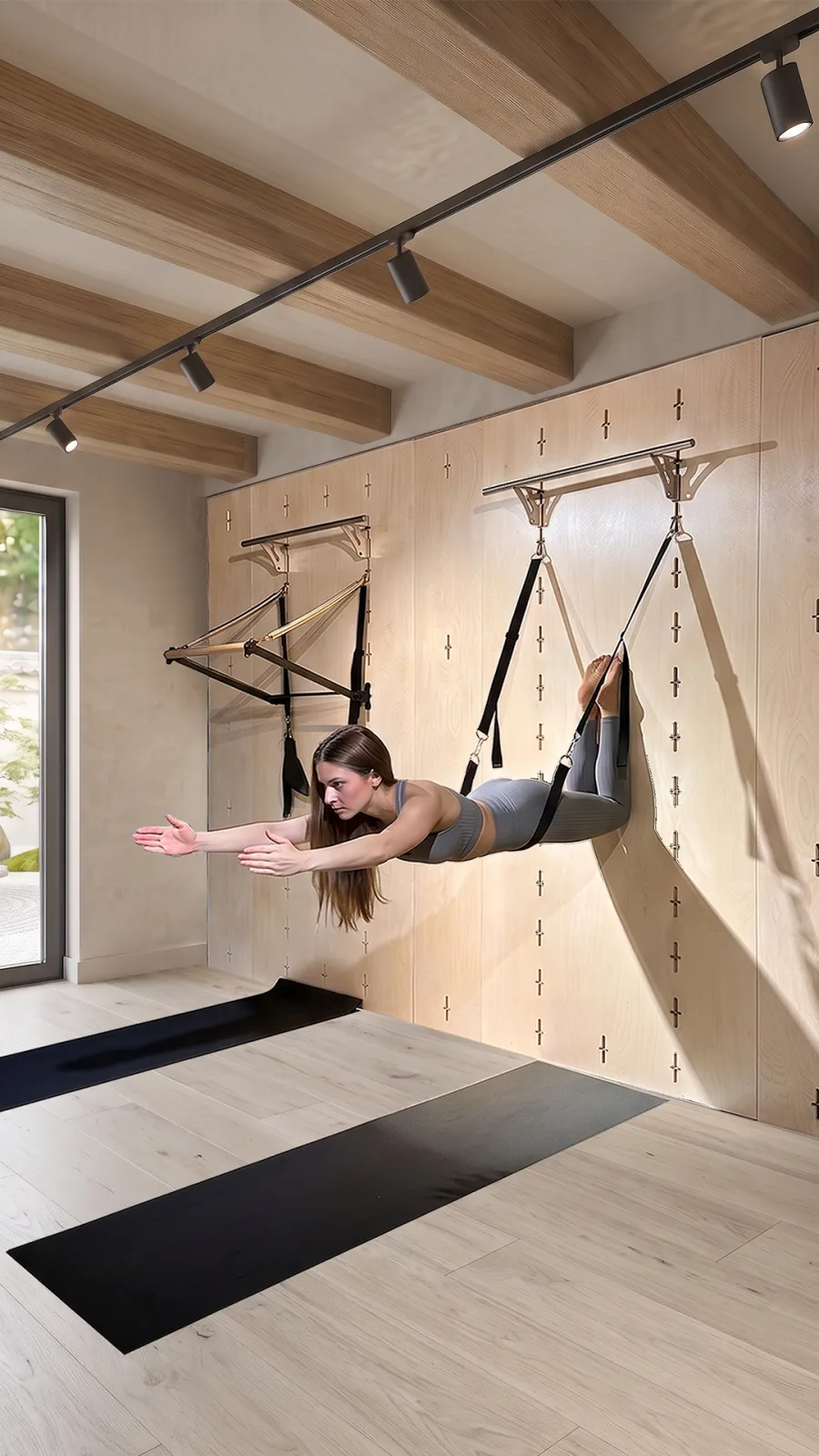
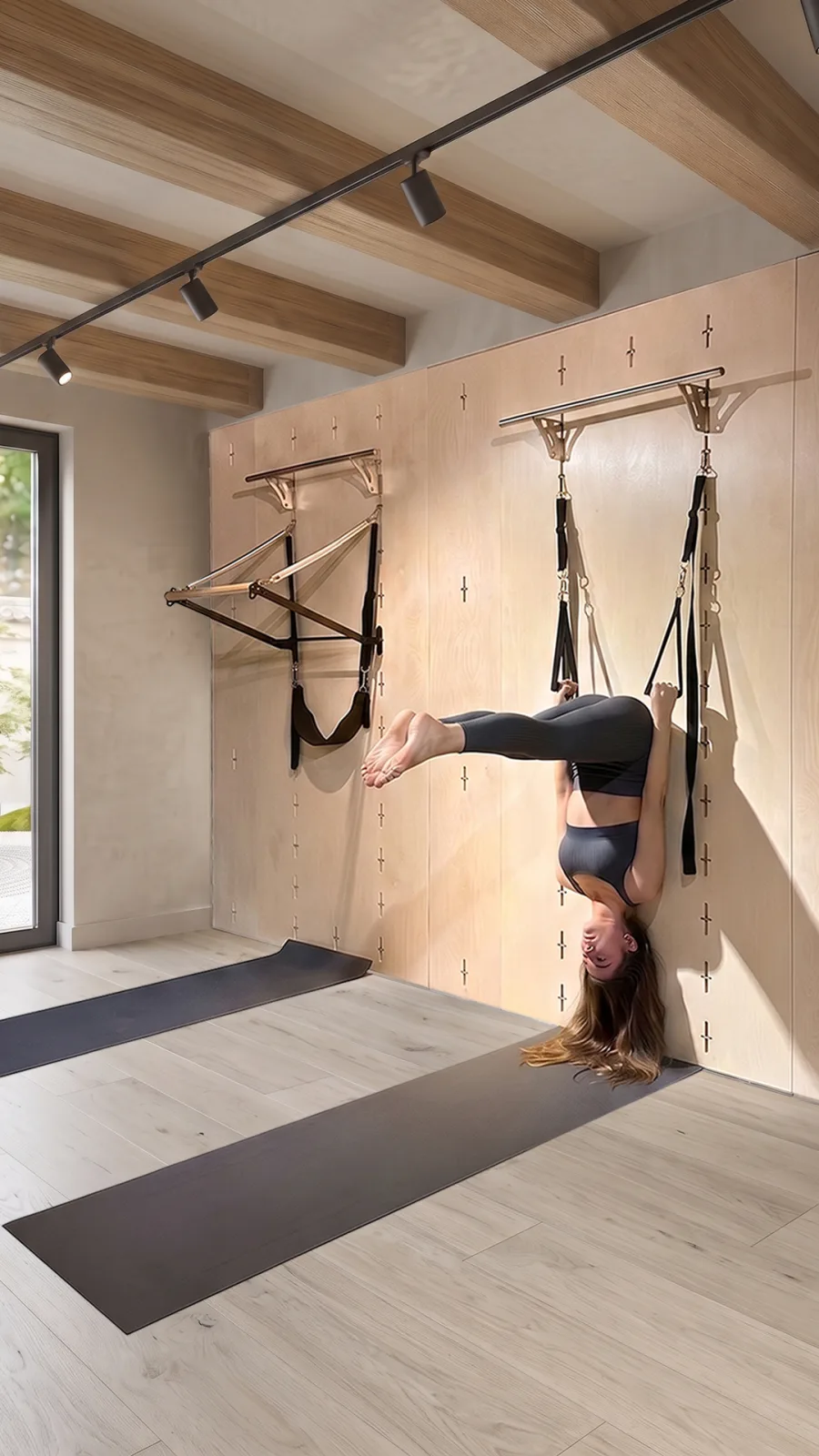
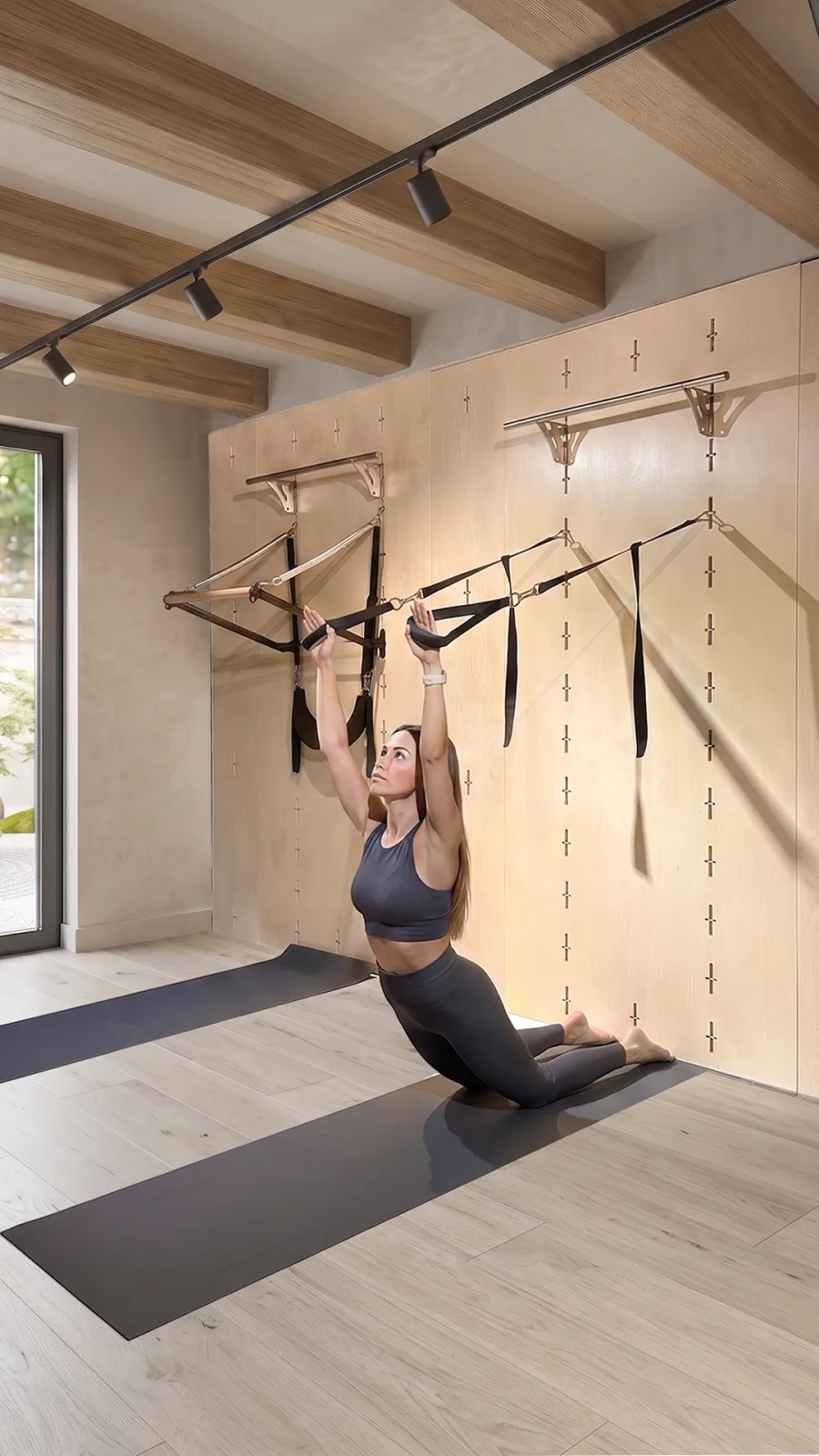
Eka Pada Adho Mukha Svanasana - Monkey
Difficulty: 2/5 — Easy
PiWall
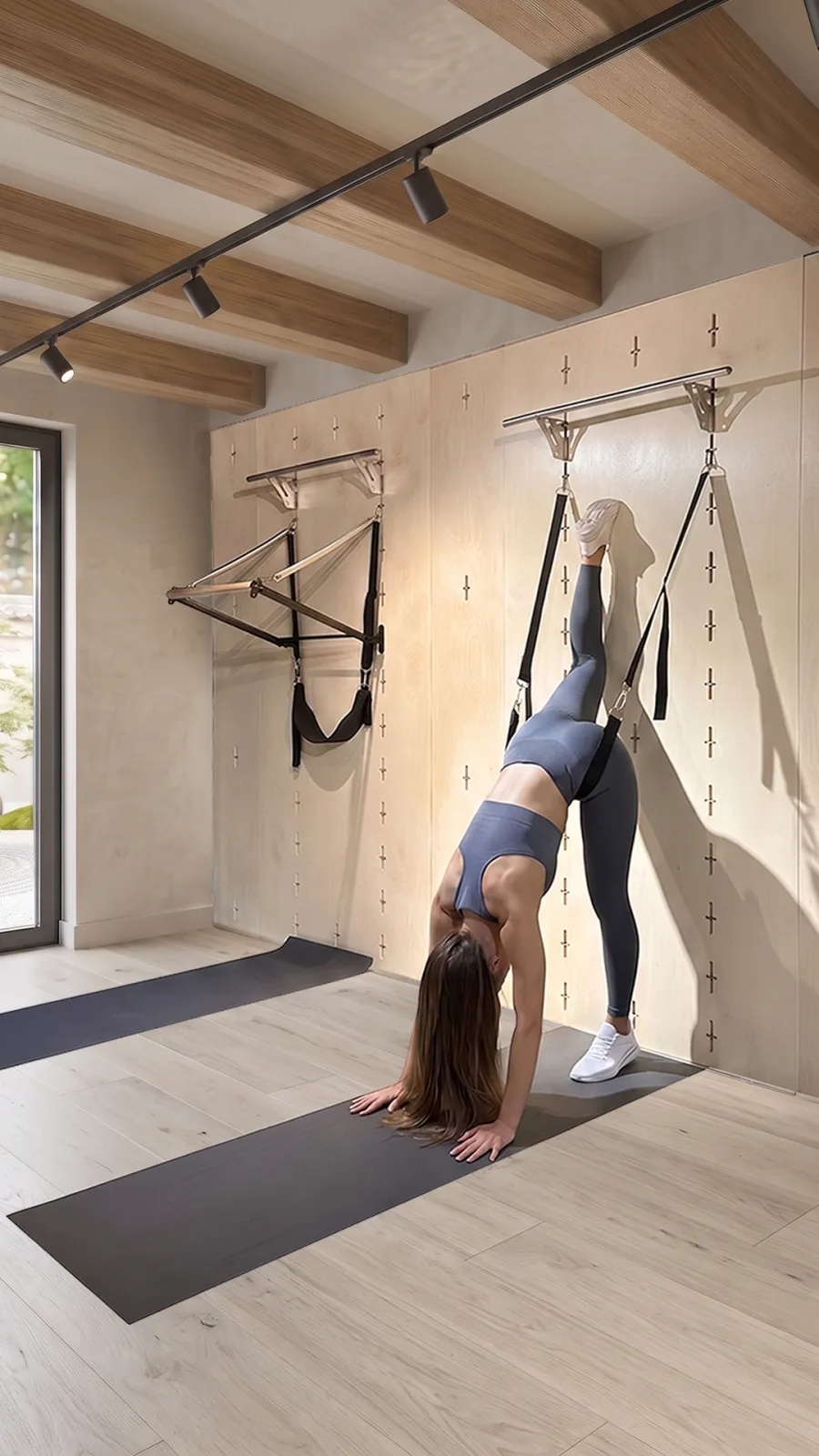
In Yoga: Fundamentally, it is a sling-supported version of the Eka Pada Adho Mukha Svanasana (One-Legged Downward-Facing Dog / Three-Legged Dog) pose. At the same time, due to the effort of opening the legs towards a 180-degree angle, it bears an exact resemblance to the Urdhva Prasarita Eka Padasana (Standing Split) pose. In Pilates: It is a much deeper, wall-adapted variation of the inverted hamstring stretch and "Monkey" series, which are typically performed on the Cadillac (Trapeze Table) with "Fuzzy" loops or spring assistance.
Also known as
- In Yoga — Eka Pada Adho Mukha Svanasana
- In Pilates — Monkey
Muscles worked
- This movement actively engages (strengthens) one half of the body while deeply stretching the other half and the posterior chain:
- Hamstrings and Calves — The posterior chain of the leg firmly planted on the ground is subjected to a maximum stretch as the torso hangs downward.
- Iliopsoas (Hip Flexors) — The front hip muscles of the leg extended up the wall open and stretch.
- Shoulder Girdle and Arms (Deltoids, Triceps, Serratus Anterior) — To keep the torso in a straight line aligned with the ears without collapsing at the shoulders, it is necessary to push against the floor actively and strongly with the hands.
- Gluteus Maximus (Glutes) — To keep the elevated leg straight and high on the wall, the glute muscle of that leg actively contracts (concentrically).
- Core Muscles — The abdominal muscles (especially the obliques) work isometrically to stabilize the spine and prevent the body from twisting from side to side.
What it gives you
- Excellent Spinal Decompression — The sling suspending the body upward directly from the groin/pelvis area allows the spine to hang freely in the direction of gravity. This completely removes the pressure between the lower back (lumbar) vertebrae, providing deep relief to the spine (traction effect).
- Safe and Advanced Flexibility — Since the need to balance is eliminated by the sling, the individual can completely release their muscles instead of tensing them (which is a natural defense mechanism). This allows for a much deeper and safer elongation in the posterior muscles of the grounded leg compared to an unsupported pose.
- Benefits of Inversion Without Neck Pressure — Unlike poses that place weight on the neck, such as the Headstand (Sirsasana), the neck is completely free here. Nevertheless, because the head is below the heart, fresh blood flow to the brain is provided, the nervous system is soothed, and lymphatic drainage is supported.
- Increased Shoulder Stability — The action of lengthening the spine by pushing against the floor ensures proper alignment of the shoulder blades and increases upper body/shoulder pushing strength. It is highly effective against postural issues caused by desk jobs, such as rounded shoulders.
Why it is rated Easy
A single-leg, strap-supported variation of the basic downward-facing dog pose.