Scissors - Supta Padangusthasana
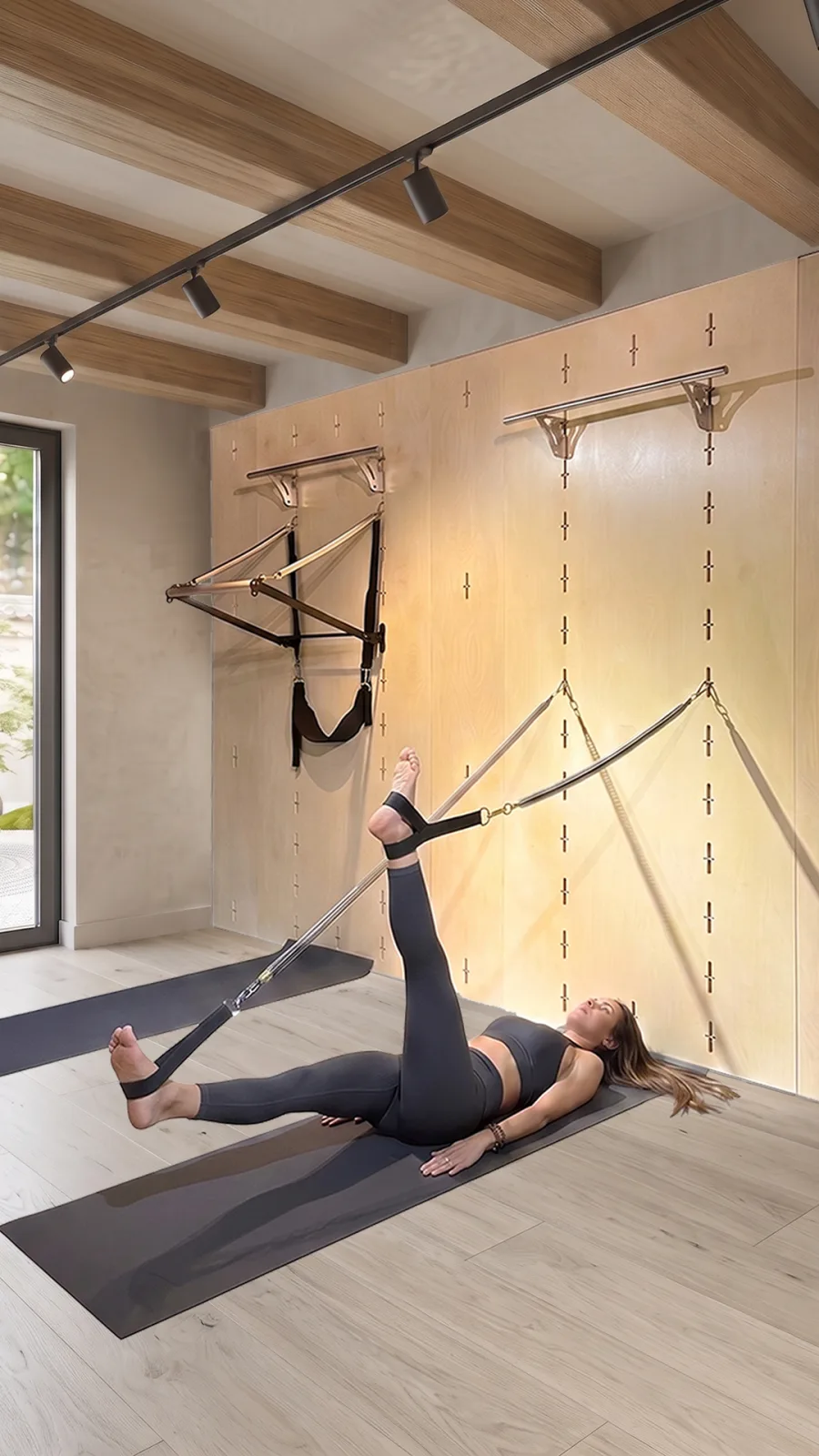
In Pilates: This position is exactly identical to the "Scissors" or "Walking" exercises in the "Leg Springs" series performed on Pilates Cadillac or Springboard equipment. Additionally, it operates on the same logic as the asymmetrical "Feet in Straps" scissor series on the Reformer. In Yoga: It can be considered a dynamic, weighted, and resistant version of the Supta Padangusthasana (Reclining Hand-to-Big-Toe Pose), where the legs are separated while lying flat on the back. While in yoga the stretch support is provided by the hand, here the springs provide it as push/pull resistance.
Muscles worked
- The legs moving in opposite directions (asymmetrical loading) makes this movement a much more challenging core test than standard double-leg exercises:
- Core and Obliques — While the legs are subjected to spring resistance in different directions, the Transversus Abdominis (deep abs) and side abdominal muscles act as tremendous stabilizers to prevent the pelvis from tilting to the right or left, and the lower back from lifting off the mat and arching.
- Hamstrings and Gluteus Maximus (Glutes) — The hamstring and glute muscles contract very strongly (concentrically and isometrically) to keep the leg closer to the floor down or press it downward, resisting the spring's tendency to pull it up.
- Iliopsoas and Quadriceps (Hip Flexors and Front Thighs) — In the upward-facing leg, the front thigh muscles are engaged to keep the leg straight against the spring resistance and prevent the spring from suddenly pulling the body (eccentric control).
- Adductor and Abductor Muscles (Inner and Outer Thighs) — They play a key role in ensuring that the legs move in a straight line directly over the midline of the body (in the sagittal plane) without swinging from side to side.
What it gives you
- Advanced Lumbo-Pelvic Stabilization — In daily life, our legs work asymmetrically while walking or running. By teaching the body to keep the core stable while the right and left legs do different things, this movement provides truly functional strength and creates a shield against lower back pain.
- Dynamic Flexibility (Active Stretching) — While the posterior chain (hamstrings) of the upward-extended leg experiences a deep stretch, the muscle is not allowed to relax; instead, it remains active against the spring resistance. Compared to passive stretching, this creates a much more permanent and safe (joint-friendly) flexibility.
- Lower Abdominal Activation with Zero Neck Pressure — The upper body, neck, and shoulders are completely relaxed and supported on the mat. The entire burden and balancing task falls on the lowest abdominal muscles. It is an excellent core exercise for those with neck or shoulder sensitivities.
- Enhanced Coordination — Producing opposing forces with the right and left halves of the body (one pushes while the other holds) significantly sharpens the brain's motor control ability and neuromuscular coordination.
Why it is rated Very easy
A fully supported, passive hamstring stretch in a supine position.