Hug a Tree - Dandasana
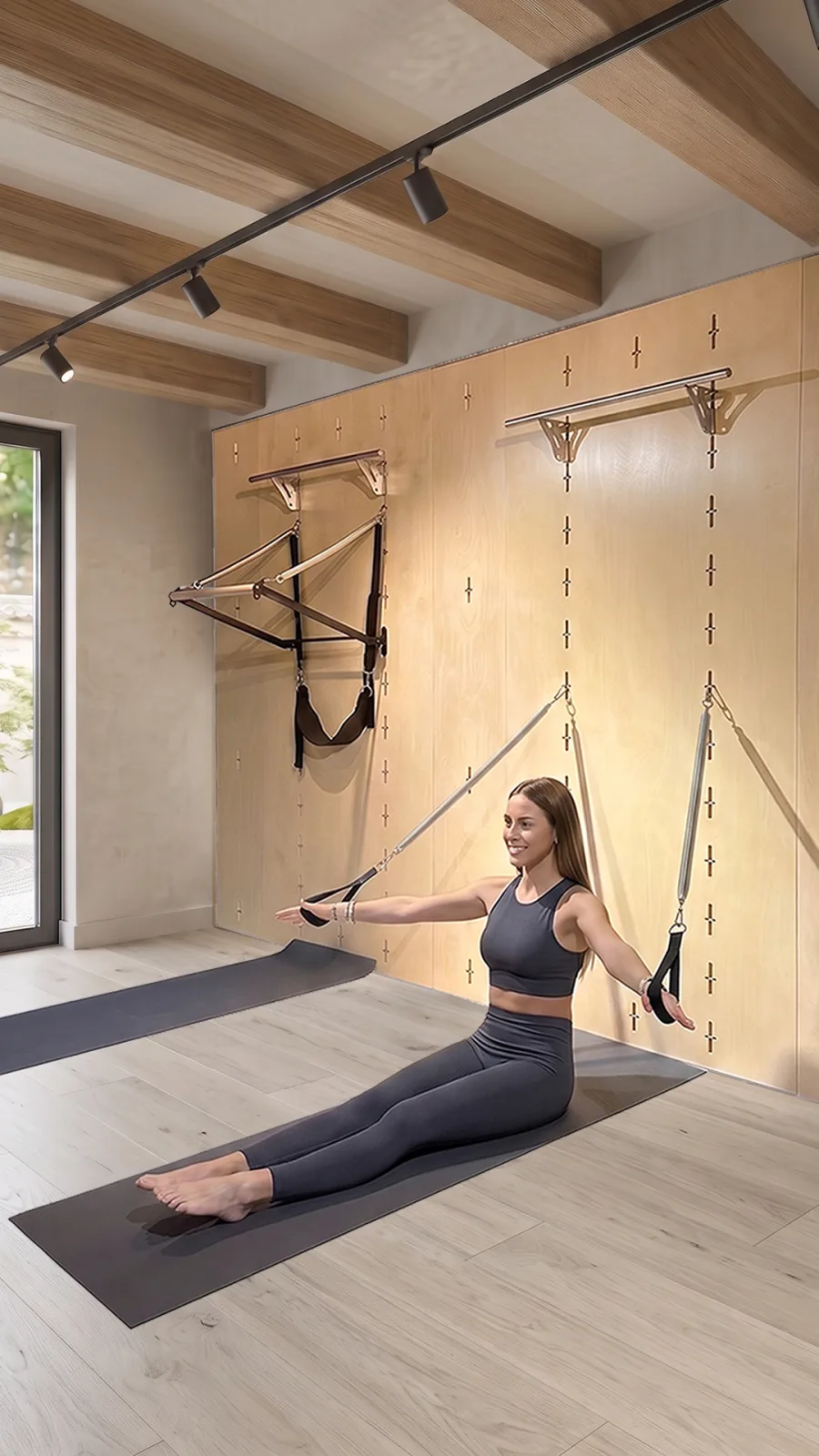
In Pilates: It exactly resembles the "Hug a Tree" movement within the "Seated Arm Work" series, which is a very fundamental sequence on the Reformer, Cadillac, or Springboard apparatus. Keeping the torso upright and trying to bring the arms together in front while the resistance comes from behind is the heart of this series. In Yoga: The position of the lower body and the perfectly upright alignment of the spine is a flawless Dandasana (Staff Pose) form. Although there is no spring resistance in yoga, the philosophy of keeping the spine upright at a 90-degree angle against gravity without support is entirely based on Dandasana.
Muscles worked
- This movement generates dynamic power in the upper body while requiring very rigid isometric (static) stabilization in the core region and lower body:
- Chest and Front Shoulder Muscles — The Pectoralis Major/Minor (chest) and Anterior Deltoids (front shoulders) act as the primary power generators to keep the arms in front against the pulling spring resistance from behind and to close them toward the center from a "T" position.
- Core Muscles — This is where the real difficulty of the exercise lies. While the springs try to pull (tilt) the torso backward, the Rectus Abdominis (abdominals) and Transversus Abdominis (deep abs) apply a tremendous braking (anti-extension) force to keep the torso perfectly upright at 90 degrees.
- Erector Spinae (Spinal Erectors) — While the abdominal muscles work, the back muscles are constantly active to prevent the back from hunching forward and to keep the spine straight in an "L" shape.
- Iliopsoas (Hip Flexors) and Quadriceps — The upper thigh muscles and hip flexors work to keep the legs completely straight on the mat with the knees locked and at a 90-degree angle to the torso.
What it gives you
- Excellent Core and Upper Body Integration — While the core muscles rest during chest exercises performed lying on your back or leaning against a bench, here the chest muscles and abdominal muscles must cooperate perfectly to prevent the body from toppling over. This provides true functional strength that translates directly into daily life.
- Posture Endurance — Being able to sit upright in an "L" shape for a prolonged period without support (without leaning back) incredibly increases the endurance of the deep postural muscles, which are critical for spinal health.
- Shoulder Stability and Control — It improves shoulder joint mechanics by teaching you how to move without shrugging the shoulders toward the ears (tensing the traps) while the arms resist the springs at shoulder level.
- Active Hamstring Flexibility — Sitting upright with the legs extended completely straight requires good flexibility in the hamstring muscles. Generating power in this position makes the gained flexibility permanent and active.
Why it is rated Easy
A seated strap-supported backward lean; provides basic core activation.