Home Philosophy Repertoire Contact

Pilateras

Repertoire

The Movement Repertoire

A growing catalogue of exercises for the Pilateras reformer, tower reformer, PiWall and studio apparatus — with the muscles each one works, what it gives you, and how demanding it is.

1 movement

Clear filters
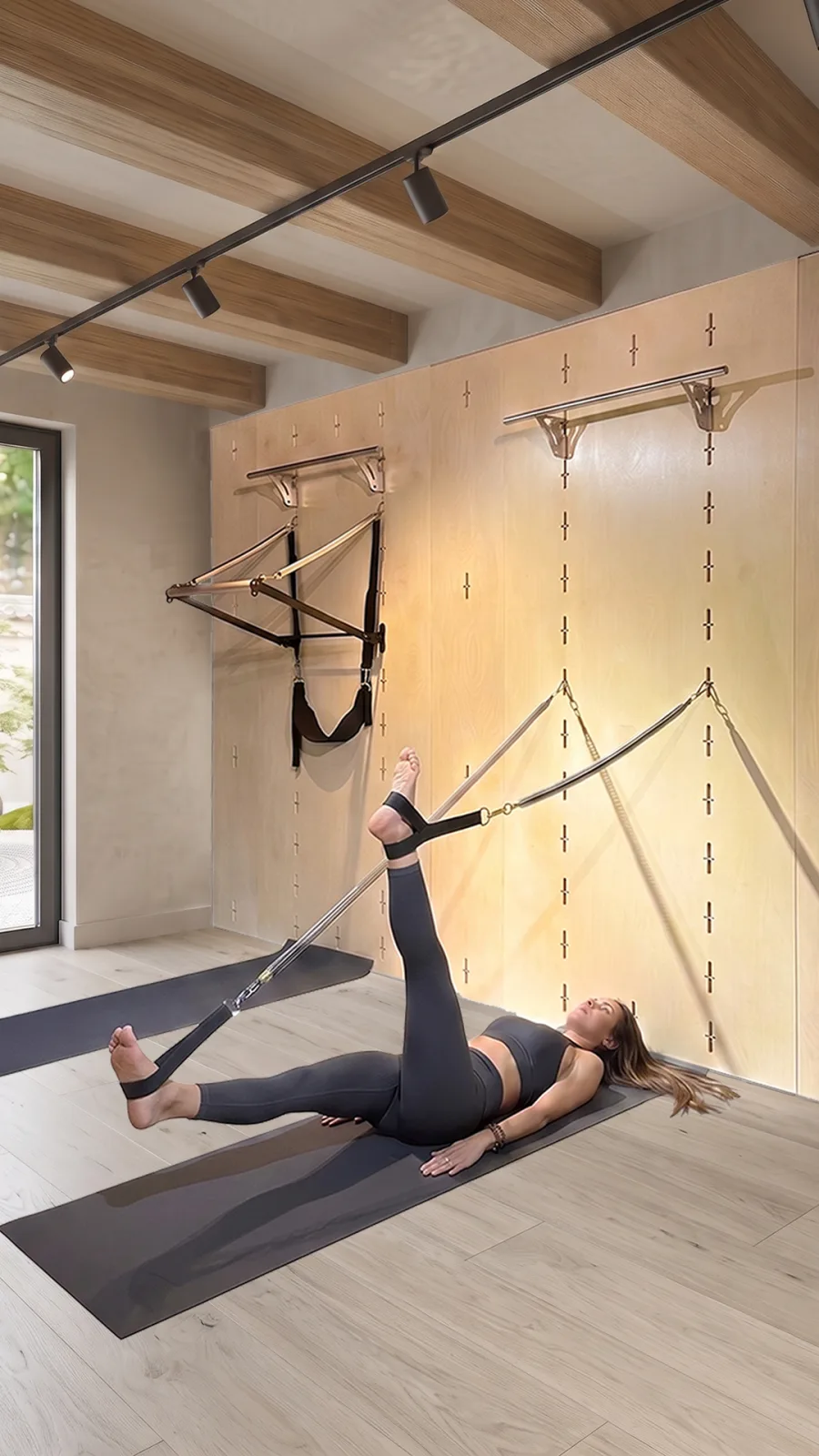
Scissors - Supta Padangusthasana
Difficulty: 1/5 — Very easy PiWall

Scissors - Supta Padangusthasana

In Pilates: This position is exactly identical to the "Scissors" or "Walking" exercises in the "Leg Springs" series performed on Pilates Cadillac or Springboard equipment. Additionally, it operates on the same logic as the asymmetrical "Feet in Straps" scissor series on the Reformer. In Yoga: It can be considered a dynamic, weighted, and resistant version of the Supta Padangusthasana (Reclining Hand-to-Big-Toe Pose), where the legs are separated while lying flat on the back. While in yoga the stretch support is provided by the hand, here the springs provide it as push/pull resistance.

Works  The legs moving in opposite directions (asymmetrical loading) makes this movement a much more challenging core test than standard double-leg exercises: · Core and Obliques · Hamstrings and Gluteus Maximus (Glutes) · Iliopsoas and Quadriceps (Hip Flexors and Front Thighs)

Read the full breakdown

How the difficulty scale works

Every movement is rated from 1 to 5 on its biomechanical demands: core activation, upper-body strength, and the balance and flexibility it asks for.

Very easy
Fully supported, passive stretches performed on the floor.
Easy
Basic pulling, pushing and stretching from a stable base — seated, kneeling, or standing with support.
Intermediate
Exercises calling for active balance, moderate flexibility, or genuine core control.
Advanced
Active inversions, plank and flight shapes carried on full body weight — high core activation, shoulder mobility, and spatial awareness.
Very advanced
Acrobatic and gymnastic shapes demanding elite upper-body and abdominal strength to hold body weight stable against gravity.