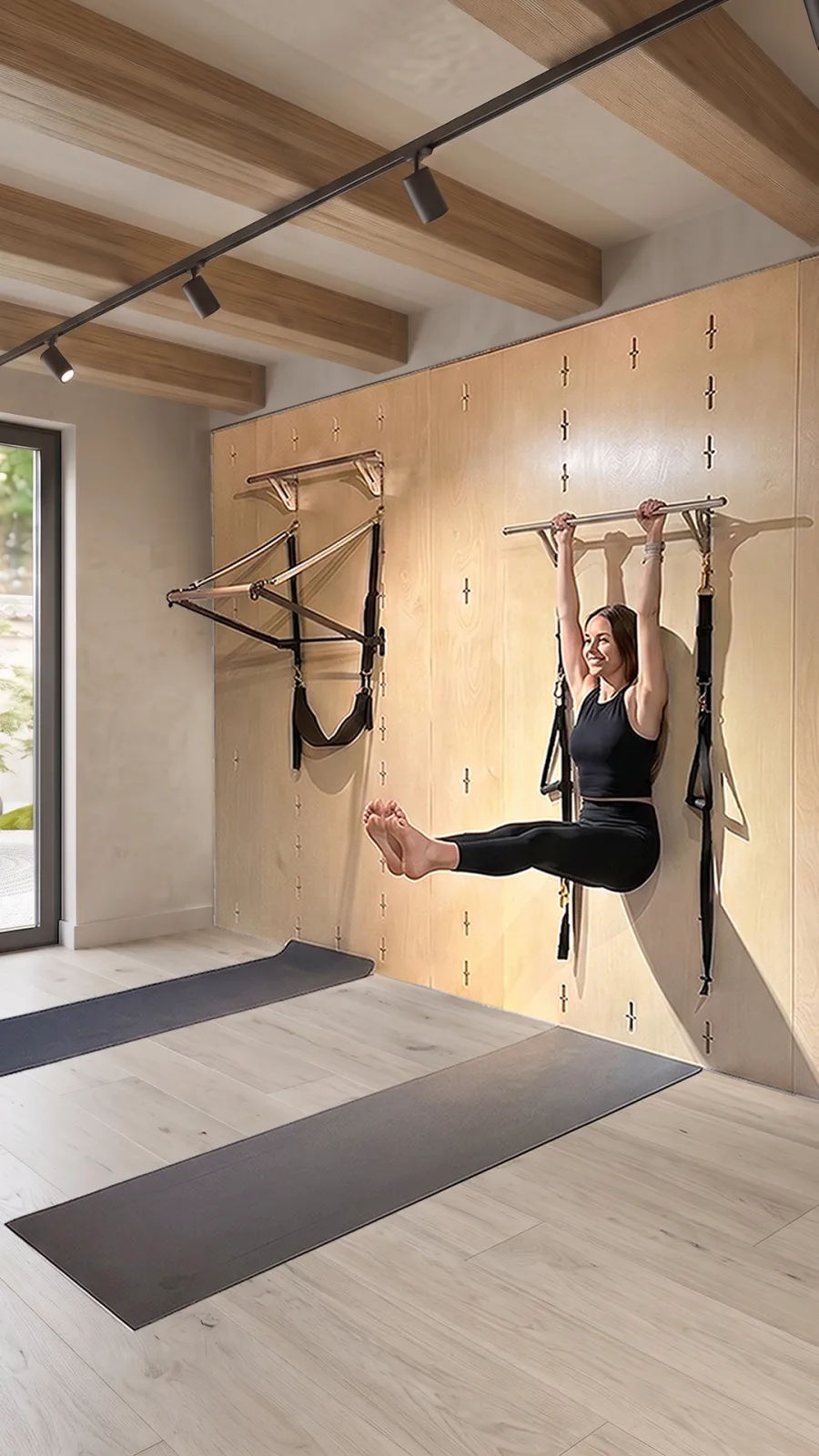
Teaser - Navasana - Hanging Leg Raise
In Pilates: It is a suspended, anti-gravity version of the "Teaser" exercise, which is performed on the mat and is one of the most challenging movements for the core region. Furthermore, it bears a direct resemblance to the "Hanging Leg Lifts" series performed by hanging from the upper bars of the Cadillac (Trapeze Table) apparatus. In Yoga: Visually and in terms of muscle activation, the logic behind the use of the hip and abdominal muscles is the exact same as in Navasana (Boat Pose). It is a suspended and more accessible adaptation of gymnastics-based yoga asanas like Brahmacharyasana (L-Sit) or Tolasana (Scale Pose), where the legs are held in the air by pushing the floor with the hands. In General Fitness: It is the classic "Hanging Leg Raise" performed on a pull-up bar; however, because the wall support here prevents swinging (the use of momentum), it is executed in a much stricter and more isolated form.
Works This movement is a high-level test of strength and endurance, requiring the upper body to remain suspended while locking the lower body in the air against gravity: · Core Muscles · Iliopsoas and Quadriceps (Hip Flexors and Front Thighs) · Back and Grip Muscles
Read the full breakdown